The Ghent Marathon was my fourth marathon, but the first with a real dedicated preparation.
My first was in 2021 along the canal in Brussels. I had set out for a 30-kilometer long run and thought: I'm at 30 km, if I run 12 more I've reached my goal. I just did it like that, and finished in 3h45.
In 2025, I ran the Spa-Francorchamps marathon, but I had totally underestimated the elevation gain (damn you, Raidillon). Great experience, but I really blew up at the end and finished in 4h. A few months later, during my preparation for the Ultra Trail di Corsica, I had a 42-kilometer long run scheduled. I went back to the canal, but it was part of my trail prep so I didn't go all out, I had targeted a pace of 5 minutes per kilometer and reached that goal.
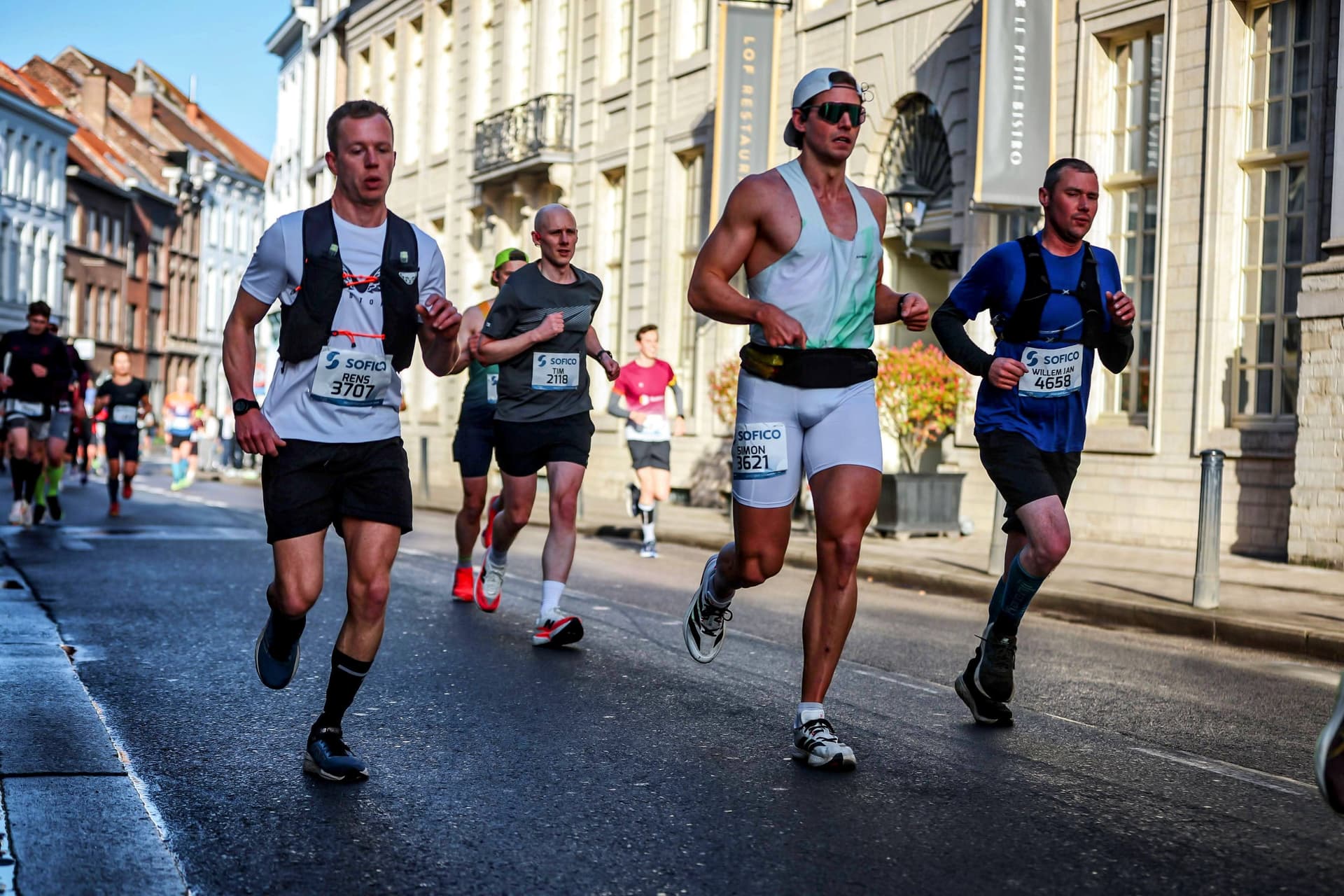
In short, it was the first time I had the right conditions for a marathon. The first and third were solo along the canal, Spa was with elevation gain I hadn't anticipated. The marathon is nothing like a 20 km or a 10 km, it's truly a distance of its own. I was eager to see what I could do with a real preparation.
The preparation
This year, I started coaching with the Running Academy. Before that I was using Runna, but it's an app a bit like Campus Coach, not specific enough. On top of that, since I also have big trail running goals, it didn't cover my needs. I love running and I wanted to improve my training, and I was recommended Matthis from the Running Academy. We started working together in 2025 and he's the one who built my preparation.
On average I was running five or six times per week, with the biggest weeks at 100 km. The specific preparation really started in January, after the Corrida Brussels (a 10 km race) in December. From there, we switched to a three-month marathon block.
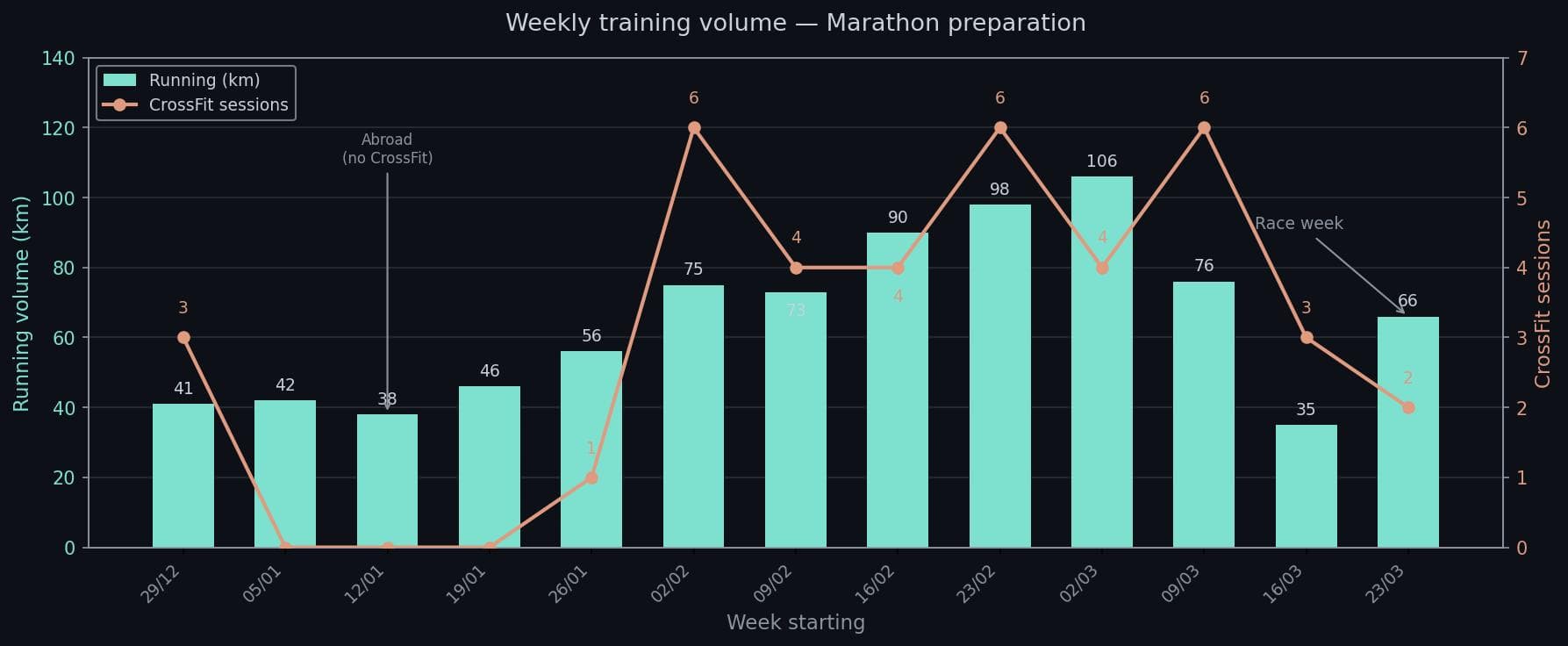
As you can see on the chart, I kept doing CrossFit throughout the preparation. Honestly, CrossFit probably helps very little for marathon performance, and I think if I had skipped those sessions I would have run a better time. But I do it because I enjoy it and because I want to progress in that discipline too.
Shoe-wise, I wore my Adidas Boston 13 on all tempo runs and long runs during the last month of preparation, roughly 100-110 km. I had experimented with the lacing to avoid pain, and it was good to have tested them before race day. The important thing is to have them well adapted to your feet to avoid friction.
The weight dilemma
I'm 1m88 and 91 kg, not exactly your typical marathon runner build. During the prep I wanted to improve and I thought: I'm going to try to lose weight. There's this rule that says one kilo less equals 5 seconds faster per kilometer.
I lost about 5 kilos, but at that point I was really weak at CrossFit, I couldn't do the exercises anymore, I didn't feel well. On top of that, flu-like symptoms hit. At first I stressed because I didn't know I was sick. I was super tired, sometimes instead of getting up to go run I would just sleep. I thought: I can't keep up anymore, it's too much, I'm overtrained, I've asked too much of my body.
When I learned I had this minor illness, it actually relieved me. My routine was there, it wasn't overtraining. Since I was weakened, I decided to stop trying to lose weight. Rather keep my natural weight, keep training to gain muscle and lose fat, but without cutting calories. Keeping the energy was the priority.
The diet itself wasn't that hard mentally, I wasn't particularly hungry. However, even though I was lighter, more dynamic, more agile on the run, there was a negative effect: with less energy, I felt less performant.
The goal
At the Corrida Brussels in December, I was targeting 40 minutes for the 10 km. I went out a bit too fast on the first kilometer so I didn't hold, but I was close. From there, I could estimate my MAS at 16.7 km/h, which pointed to a potential marathon pace of 4'30.
In training, Matthis saw that 4'30 was a bit too fast. MAS gives you a range, but by looking at heart rate and training sessions, we refined it. We settled on 4'40 as the target pace.
Ghent, Sunday March 29th
I arrived in the morning, the race was great. The weather was beautiful but cool, around 5-6 degrees. I went to a thrift store to buy a pullover to wear before the start and abandon at the starting line.
I hesitated quite a bit about the outfit. I always run in a singlet, but with my build I tend to heat up very fast. I considered wearing arm sleeves, but I figured I'd end up taking them off. I went without and it turned out fine.
Kilometers 1-20: easy
The course is superb. The first 20 km, honestly, it's easy. I was very careful to follow my 4'40 pace, because I knew that if I went a bit faster I could cross into threshold territory, and that's not ideal. I really didn't want to get carried away: at the 10 km race, I had gone a few seconds too fast on the first kilometer and it had put me in trouble.
Something that really helped was a trick I saw on Instagram: adding the average pace per kilometer on my watch, in addition to the instantaneous pace. The instantaneous pace jumps around because of GPS bugs. The average pace is much simpler to regulate with. If I'm at 4'35 average with 200 meters left, I know I can ease off a bit. It allowed me to be a metronome.
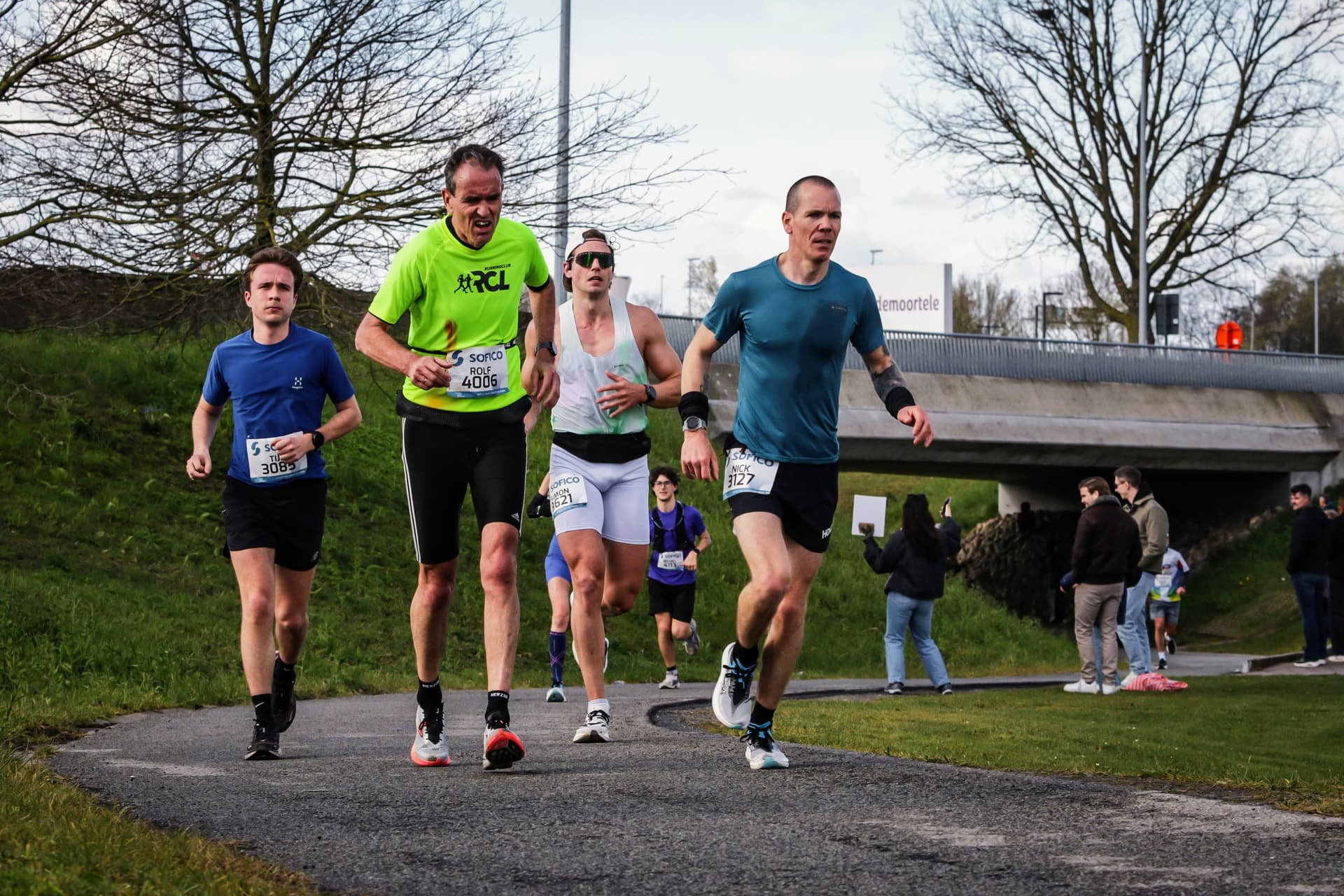
I also drafted behind certain runners who were holding a steady 4'40. You had to be careful because sometimes they'd speed up. When I saw on my watch that the guy was going 4'30, 4'25, I'd let him go. But there was one I followed for 8-10 kilometers, it was perfect: I tucked right behind him and it shielded me from the wind.
The Ghent course is really beautiful. You pass through small areas where there are lots of people cheering, sometimes in narrow passages with people right next to you, it's motivating. And there are sections on bike paths along the canals, long straight lines stretching for kilometers. Beautiful in nature, but you really feel the wind. Drafting helped a lot on those exposed sections.
Kilometers 20-30: it burns
Between the 20th and the 30th kilometer, the muscles started to burn. Glutes, hamstrings, and toward the end the shoulders too. I was trying to relax a bit.
The shoulders surprised me because I'd never experienced that before. I think I wasn't relaxed enough in my upper body. It's a bit like the feeling in Hyrox when you do the farmer carry, holding weights at the end of your arms. I thought: « what's going on, I'm not carrying 20 kilos in each hand, why is this happening? »
Kilometers 30-42: the paradox
The last 10 kilometers, there's a paradoxical effect. On one hand it's clearly the hardest part of the marathon. But on the other, when you start seeing the number 3 on your kilometer counter, you know there are only 10 left. There's a real boost of motivation.
Nutrition-wise, I had planned 45 grams of carbohydrates every 7 kilometers, roughly every half hour, plus a gel right before the start. My very last gel, arguably the most important one, was at the 35th kilometer. I took it from my belt and it slipped out of my hands. I wasn't quite lucid anymore I think. I thought « oh no », but I kept going, I didn't stop. I ran the last 7 kilometers without any fuel.
It was a mistake because at the aid station there were candy, gels, fruit compotes. But I was too focused, I hadn't noticed, I didn't want to lose time. That's part of the race day surprises. On top of that my gels didn't contain electrolytes, and I got a small cramp. Something I'll pay attention to next time.
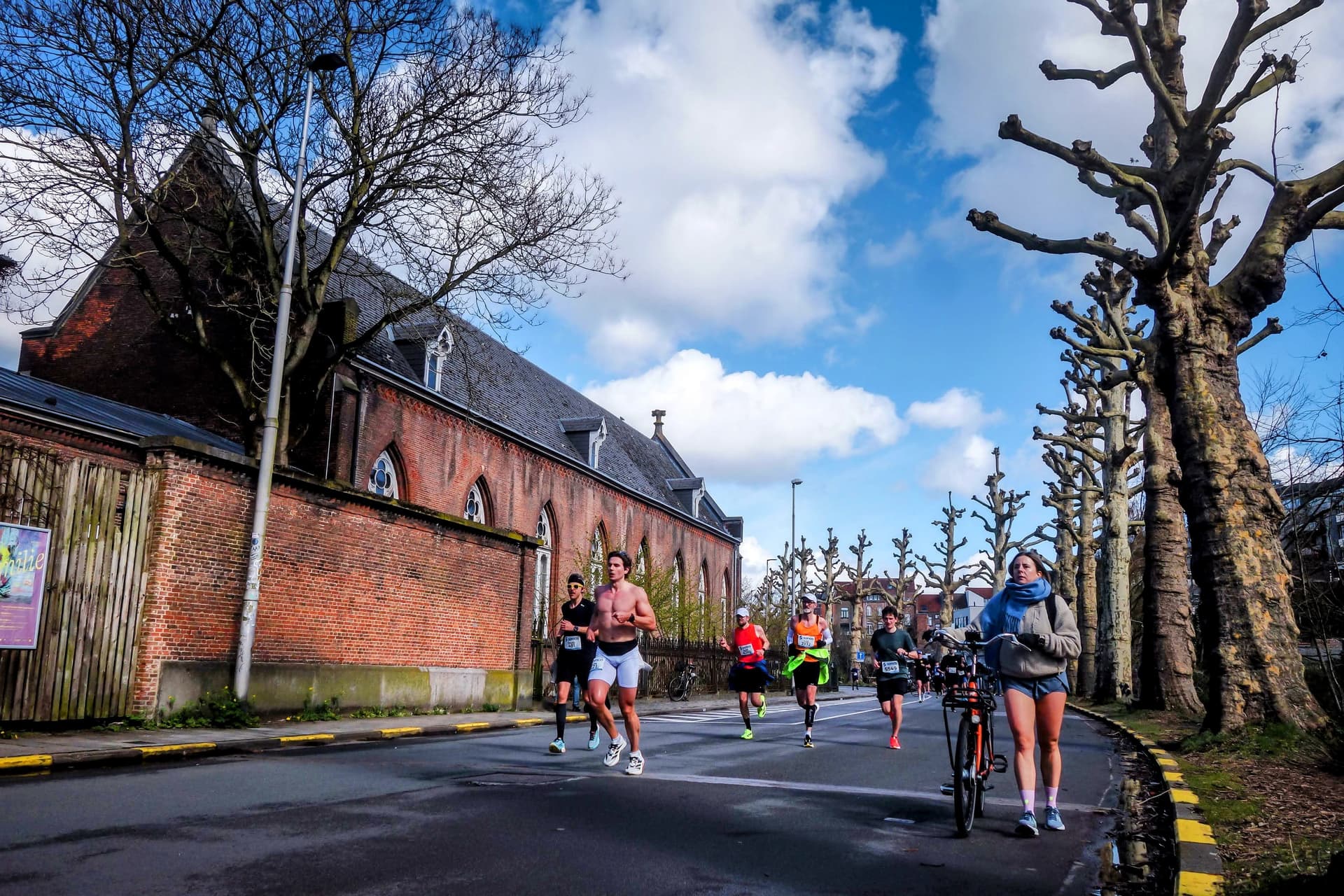
The lack of carbs at the end definitely played a role. The last 2-3 kilometers I slowed down, ran them at 4'50, 4'55, the very last one at 5 minutes. But since I had banked a little time earlier, it balanced out and I maintained an average of 4'40 on the dot. It's pretty funny to land exactly on the target number.
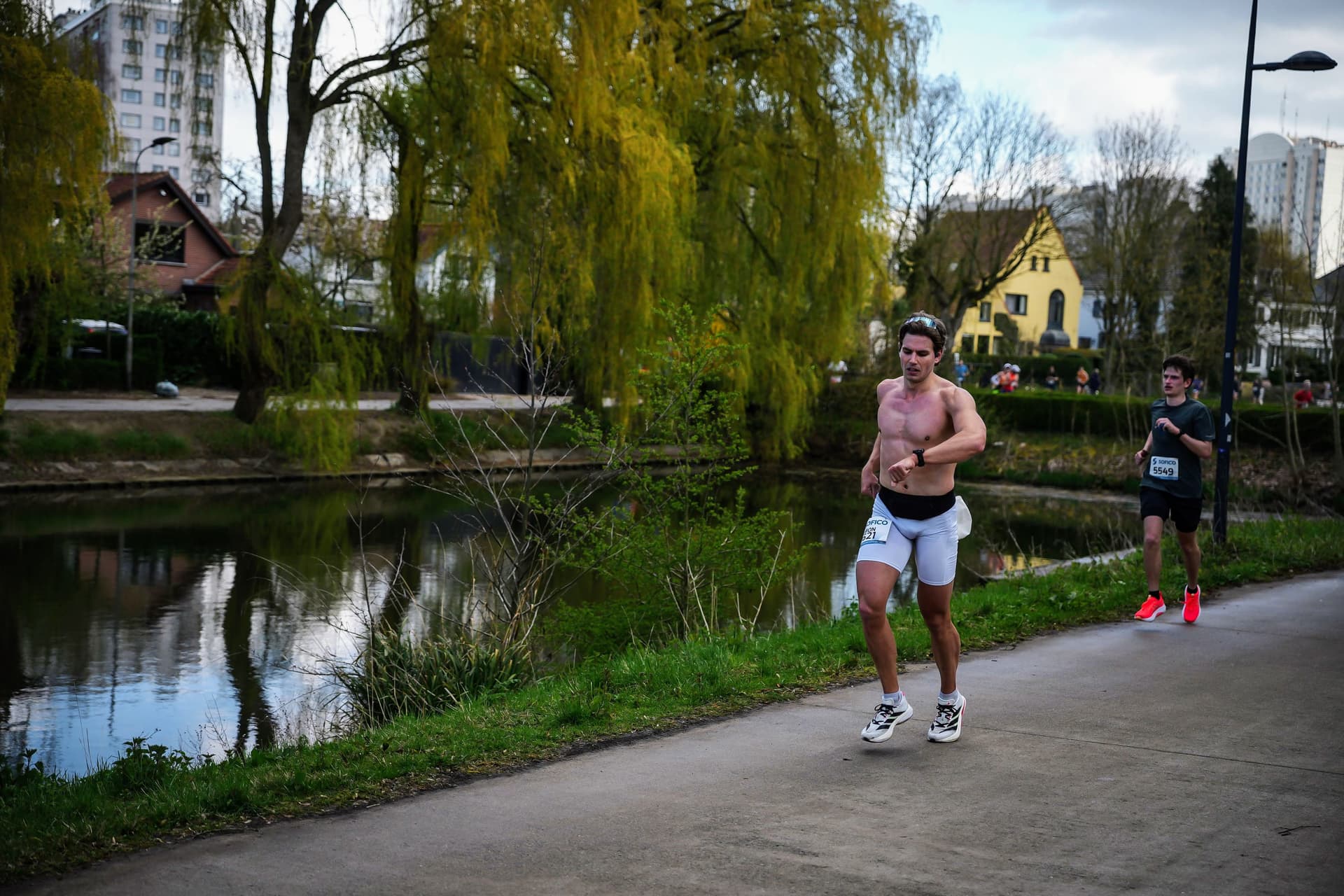
Around kilometer 37, I was really hot so I decided to take off my singlet. It's something I always keep as a boost: the wind evaporates the sweat and gives me better thermoregulation. Obviously the last kilometers of a marathon are the perfect moment for that. And since my build stands out a bit from the typical marathon runner, quite a few people in the crowd started cheering me on with things like « let's go beast! ». That was pretty funny.
In the final kilometers, I also followed another runner who started talking to me in Flemish. I didn't understand a word and told him « English or French? ». We ended up chatting a bit during the race: we agreed to hold the pace until kilometer 37 and then try to pick it up. He was targeting 3h15.
The finish: the indoor stadium
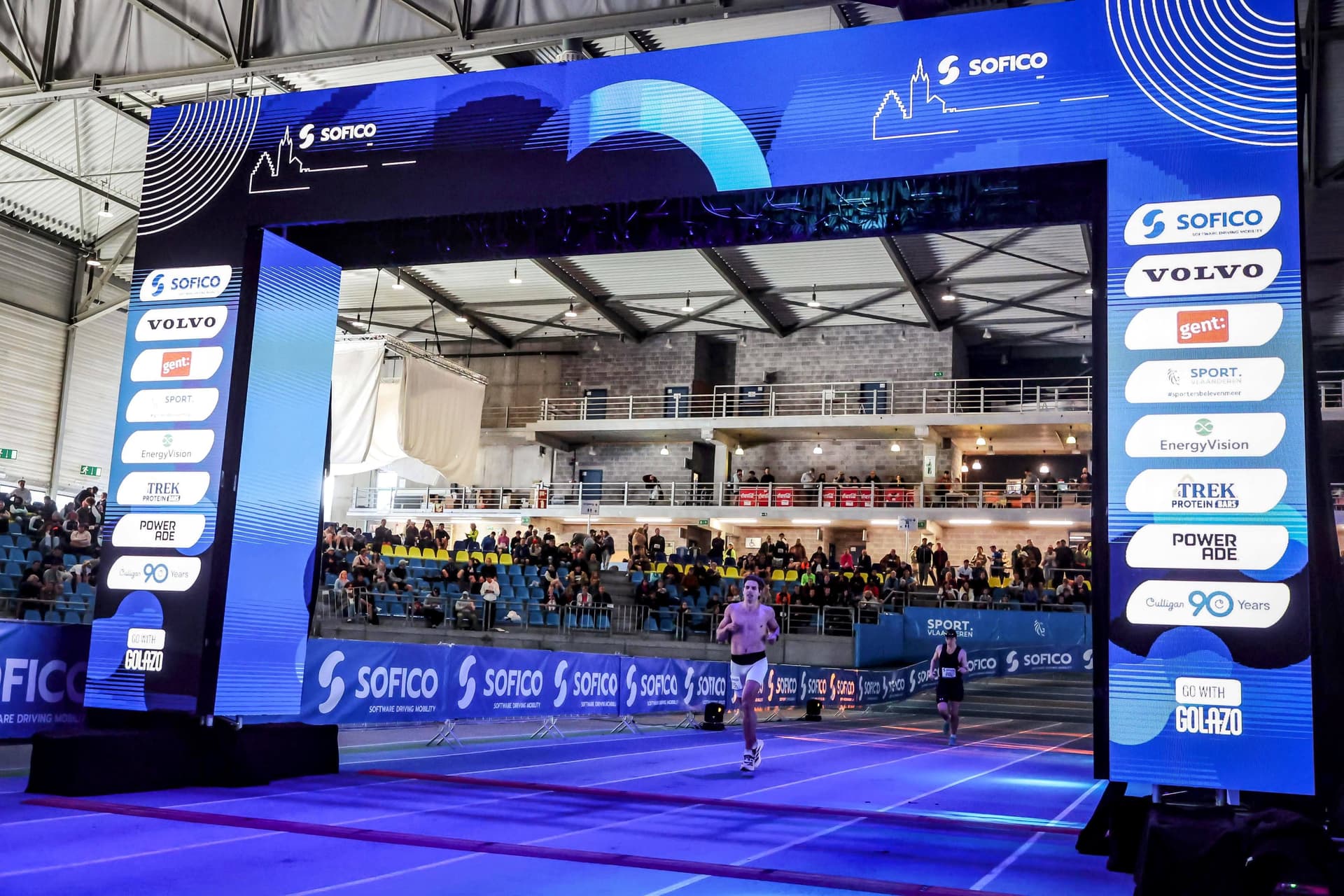
At the finish we were together. The Ghent Marathon ends inside an indoor stadium: you enter, run a lap on a 400-meter track with the crowd in the stands. It's absolutely magnificent, you're really fired up. I remember I started semi-sprinting, passed a guy in the final meters. The atmosphere was truly electric, exhilarating. My companion from the last kilometers finished in 3h15min30s, he was happy.
My friend Martin was there too, we had dinner together the night before. He lives in Ghent and was running the half marathon starting at 1:30pm. I arrived around 12:20, so we had time to debrief before his start.
3h17'31"
Honestly, I went in not really knowing what to expect. I followed the plan, but with the minor illness and a rough patch at the end of the prep, I wasn't sure how it would go. I told myself: just go and do the work. And it worked out.
The prep was done. The long runs were in the legs, the 20 km at marathon pace in the middle of a 90+ kilometer week were done. I went in without overthinking it, and race day went well. A good preparation, I think that changes everything. The marathon doesn't forgive, and when the conditions aren't right, it usually doesn't pay off.
I absorbed the training load well. When you have a bad marathon it passes extremely slowly, and this one went by fast, even though the last kilometers were super long. I was well within my paces, I hadn't gone out too fast. Physically and mentally, you recover quickly when it goes well.
I can see there are still areas for improvement, and that's motivating. I'm starting to know myself well as a runner, and it's important to appreciate these milestones.
I still love it just as much, that's for sure. If I had to give one piece of advice to someone preparing for their marathon: enjoy what you're doing. That's really the point, have fun with it.
Thanks to Matthis for the coaching and the preparation that made all of this possible.
What's next
The next big goal is the 70 km by UTMB in Romania, end of July. Until then there will be a few smaller races in B-race mode: a Hyrox and a CrossFit competition, which will be my first.
I also have a road race date at the end of May, the 20 km de Bruxelles. It's the most popular race in the city, almost 30,000 participants. The idea is to fit it into the trail preparation while keeping one speed session per week. It's important not to lose what's been built, but the priority will shift to trail and elevation work.
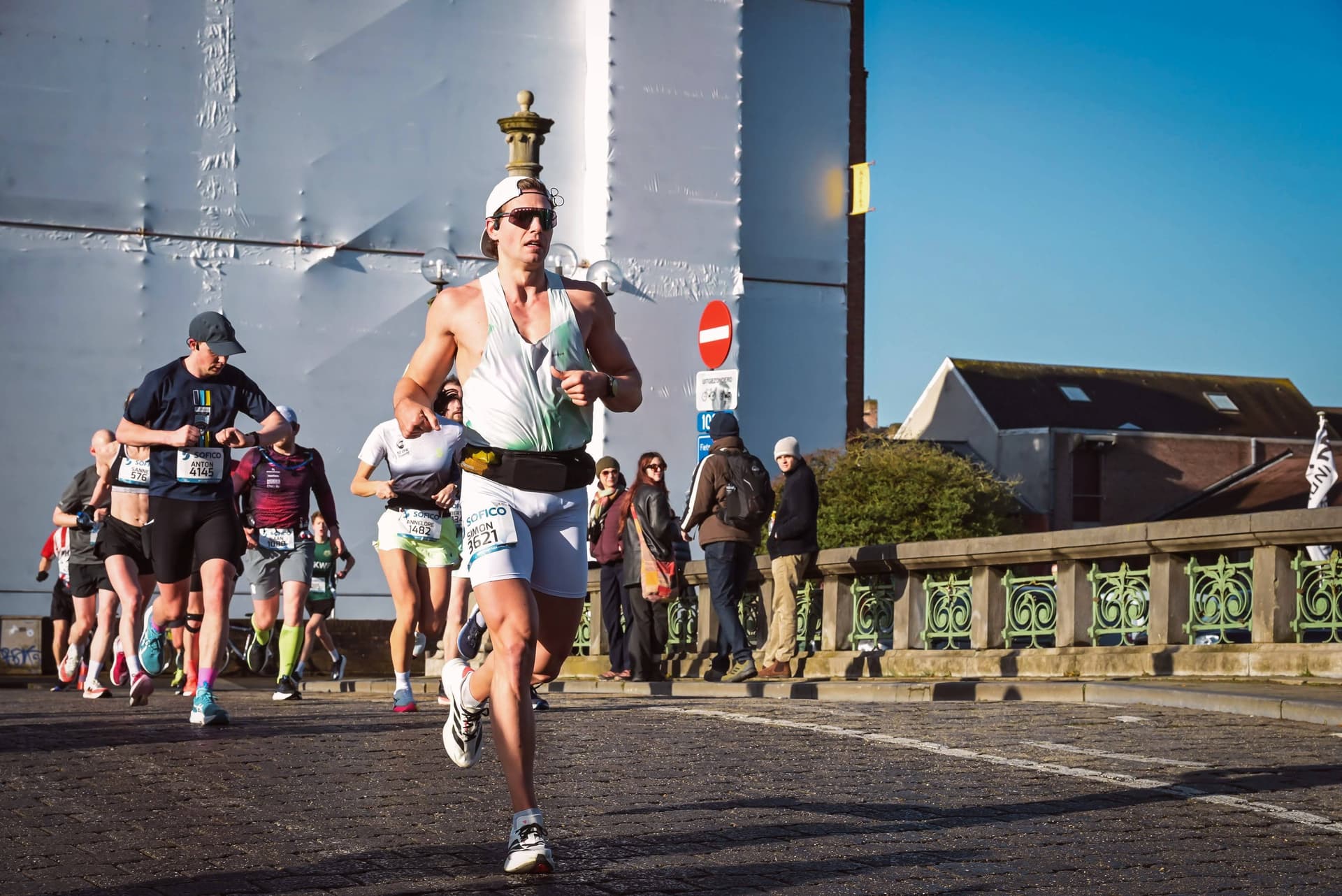
Ghent was a great marathon, not too much elevation. I like running close to home, I live in Brussels, and it's nice to take the train rather than a plane. But I like variety: there are other marathons not far away that I haven't tried yet, Namur, Paris maybe. I'd happily do Ghent again, but I'll probably go discover another one.
I'm thinking of doing the same kind of program next year: a marathon at the end of winter and then back to trail.