So, if you've been following my adventures here, you know that last year I ran my first two big "100-mile" UTMB-format ultras: the Restonica Trail in Corsica and the Julian Alps in Slovenia. And I have to tell you the truth about those races: I didn't run them, I survived them. By the end I was in pure damage-control mode, finishing on foot, jogging a bit here and there, but really struggling. After Corsica, it took me several weeks just to heal the race wounds. And those sleepless nights, two nights without sleep in Corsica, really left a mark on my body.
So this winter I told myself: what I want now is to improve, get a bit faster, and eventually come back to those big formats, but not right away. First, I want to learn to run an ultra. Not finish it, not survive it: run it, from start to finish. So I looked for races around 100 km-effort, and above all races that start in the morning, so no all-nighter.
That's how I came across the Bucovina Ultra Rocks by UTMB, in Romania: the Four Summits format, 72 km and 4700 m of elevation gain, four summits in the Eastern Carpathians, starting Saturday at 6 am. One day of racing, a genuinely normal day: start at sunrise, finish before dark. Ideal. And worst case, a finish in the evening if I dragged, but I could still get a "normal" night afterwards.
My goal was simple to state: run this race from start to finish (except uphill of course, it's still trail running).
That's what happened.
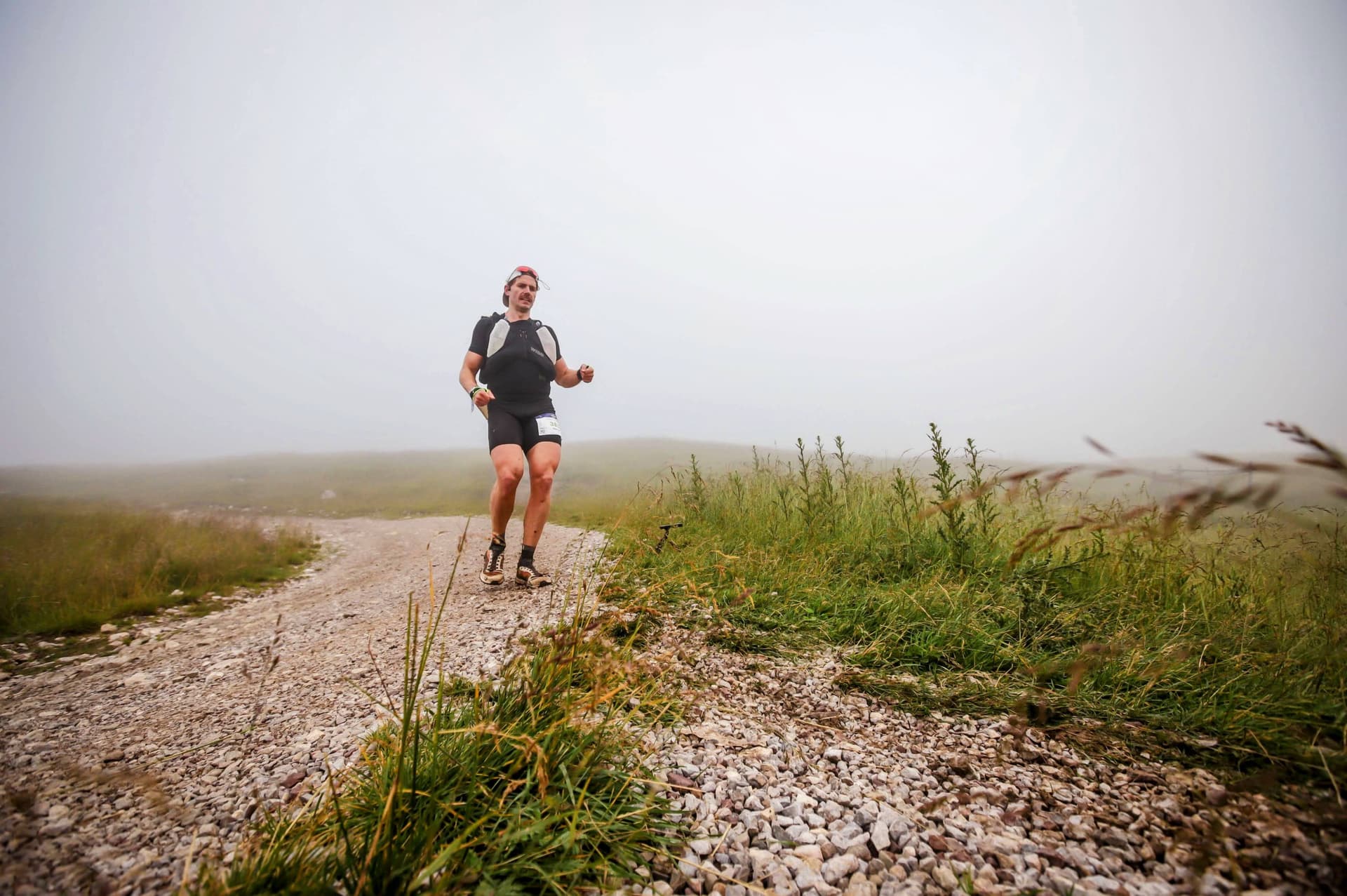
A far-from-ideal build-up
I have to be honest about my preparation, because it's not the glorious part of the story. At the end of March, I ran the Ghent marathon in 3h15, that was the good news. But afterwards, between a complicated few months and up-and-down shape, I simply didn't train much (for my taste, everything is relative of course). My Strava weeks speak for themselves: after the 98 and 106 km weeks of the marathon block, I dropped back to weeks of 35, 30, sometimes 16 or even 11 kilometers. From April to June, my average sat around 35-40 km per week, and I didn't run a single outing longer than 20 kilometers.
What saved me, I think, was two things. First, CrossFit, faithful all year round, three to five sessions a week: I'll never be a featherweight on the climbs, but I've got an engine and a strong core, and on an ultra that ends up counting, it's what lets you finish and keeps the injuries away. Second, the Chouffe Trail at the end of June: 53 km and 1600 m of climbing in the Ardennes, four weeks before Romania. It was my crash test, and it did its job beyond my hopes.
Because the Chouffe taught me three things. One: my nutrition strategy held up, 80 grams of carbs per hour for 7 hours, without ever feeling sick. Two: my weak points are now identified. The glutes, which get cooked when I attack the climbs too hard, and above all the feet, sore from the impacts of bombing descents with long strides. The lesson for Romania was clear: don't hammer the climbs, and take small steps downhill to spare all that. And three, the most reassuring one: despite the skeletal build-up, the level was there. I posted a performance very similar to last year's Ohm Trail XL (50 kilometers and 2500 m of climbing, wrapped up in 8h30), except back then I was in full Ultra Trail di Corsica prep, stacking 100-kilometer weeks. This time, not at all. I also held an average of about 160 bpm for 7 hours, which is already interesting in itself. But above all, I strongly picked it up again over the last 10 kilometers, above 10 km/h after six hours of racing. And that's not always a given: it meant there was still fuel in the tank, and that the engine didn't only depend on running volume.
The plan
For the first time, I went into a race with a real written plan, prepared down to the smallest detail. And I have to say it changed everything. I ping-ponged with Claude to define it.
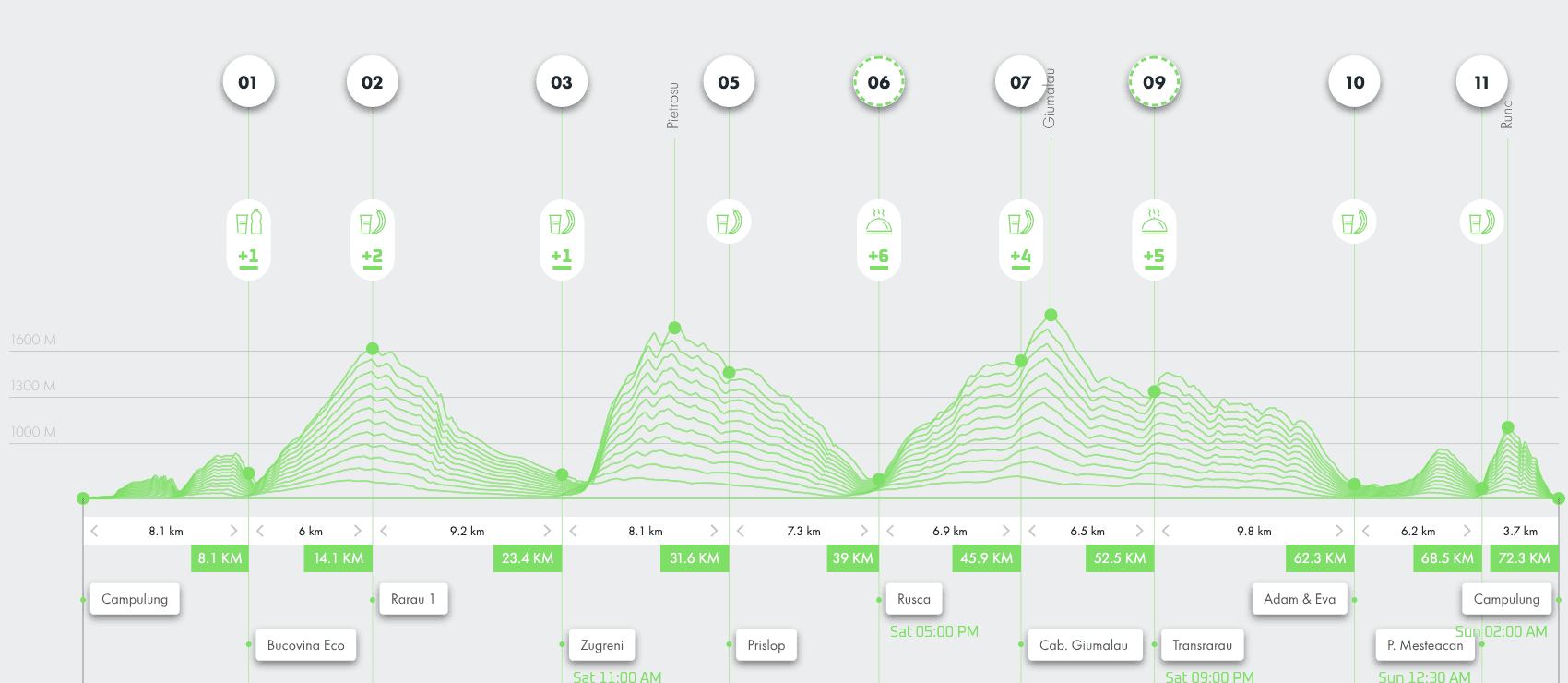
Pacing first. The race broke down into three sections, with rules simple enough to remember even with 10 hours of racing in the legs. Section 1, to Zugreni (km 23): never above 150 bpm, never faster than 6'30 per kilometer, vertical speed capped at 700 m/h. Section 2, to Transrarău (km 52): 155 bpm, 6'45, 650 m/h. And after Transrarău: release, 165 bpm allowed, no more pace limit, the race starts there. Three triplets sliding the same way: the further the race goes, the higher the heart gets to climb and the freer the legs become.
Nutrition next. At the Chouffe, I had done everything on gels: twelve gels at 45 grams of carbs for a weight of 75 grams, nearly a kilo on my back. It was Matthis, my coach, who pushed me to change doctrine: fewer gels, more drink mix, and lean more on the aid stations. The principle is mathematical: what you eat at an aid station weighs zero grams in your pack, the powder gives you 33 grams of carbs for 38 grams carried, the gel 45 grams for 75 carried. The result: one gel every 80 minutes on a watch alarm, one 500 ml flask of sports drink refilled at every aid station, one or two cups of Coke and something solid in hand on the way out. At Zugreni, before the longest stretch without support, one planned exception: both flasks filled with mix. In total, about 80 grams of carbs per hour, for 250 grams less on my back than at the Chouffe.
And then the watch tips, because that's where I bought my peace of mind. I turned on ClimbPro on my Garmin, which shows the remaining climb for every ascent: magic for knowing when to pull out and stow the poles, and when a flat section is coming so you can jog it. And above all, I downloaded the official course GPX and added every aid station myself, manually, as a course point on the map. So my watch permanently displayed: next aid station in X kilometers. Before, I used to do exhausted mental math ("I'm at kilometer 42, the sign says 15 kilometers to the next aid station, so 42 plus 15, 57") and I'd get it wrong or forget every other time. Now the information was just... there. A detail, and yet a real clutch factor for my race.

The day before, one last weather check: 10 to 19 degrees announced, changing skies, showers possible. For a frame like mine that suffers as soon as it gets hot, that was a gift.
Start, Câmpulung Moldovenesc, Saturday 06:00
The alarm goes off at 3:30. Coffee already prepped, brioche toast with jam, NOK anti-chafing cream everywhere, a bit less on the feet than usual, the Chouffe having taught me that my socks were doing the job. At 4:30 I leave my accommodation, at 5 I'm on site. An hour early, comfortable. Of course, time flies: twenty minutes of music in the car, then I step out... and I see a pair of Shokz OpenRun earphones on the ground. The guy who parked next to me, obviously. Off I go on a mission through the race village to find a stranger I glimpsed for ten seconds in the half-light. I spot a familiar cap: "Hey, aren't you the one who parked next to me? Didn't you lose your earphones?" It was him. He was happy, it was nice. And me, it's 5:40 and I'm half dressed.
Back to the car at a jog, sweatpants off, shorts on, nutrition spread through the vest. I get to the line six minutes before the start, swallow my first gel, and off we go.
Well, off we go... slowly. Because the plan was clear: I place myself deliberately at the back of the pack. I know the front will go out fast. Even "not very fast" at the start of a 70 K is already too fast. Me, I have my 6'30 per kilometer to respect, my easy-endurance pace of the bad mornings. The race sets off on two kilometers of asphalt, and I'm last. Simply last, with maybe five people behind me. I look at my watch: 6'15. "No, slow down, buddy." I settle back onto 6'30 and let the pack pull away.
In the first little forest, I hear two guys talking with a familiar accent. Belgian flag on the bib: there are five Belgians in the race, here are two of them. Jean-François, a seasoned very-long-distance trail runner, and his buddy François, whom he converted to trail running and who is racing his first 70 km here. They're doing the race as a pair, we chat for ten minutes. Meanwhile, I watch my watch like a hawk: under 150 bpm, the moment it climbs, I slow down. I know myself, I get carried away fast.
A quick pit stop before the second climb. I lose a few more places, and now I'm truly alone at the tail of the race. I climb following my numbers. It's in that climb that I meet three Romanians, friends born in the region. One of them is taller than me and announces 100 kilos. Seriously, respect to him for coming after this kind of event at that size. They've already run this race several times, so we talk terrain: it rained the day before, runners have already been through, and it's muddier than anything I've ever known. Whole zones of standing water where you are flat-out wading through mud. First time in my life racing on ground like that. They tell me that last year it was 25-30 degrees: "It was terrible." I take their word for it, generally, the heavier you are, the hotter you run. It feels like 10 degrees, I'm in shorts and a t-shirt, a light shiver. "Should I put on a layer?" No. Just keep moving, it'll pass. It'll pass. In the descent that follows, I feel that my new shoes aren't tight enough, so I stop to cinch everything down.
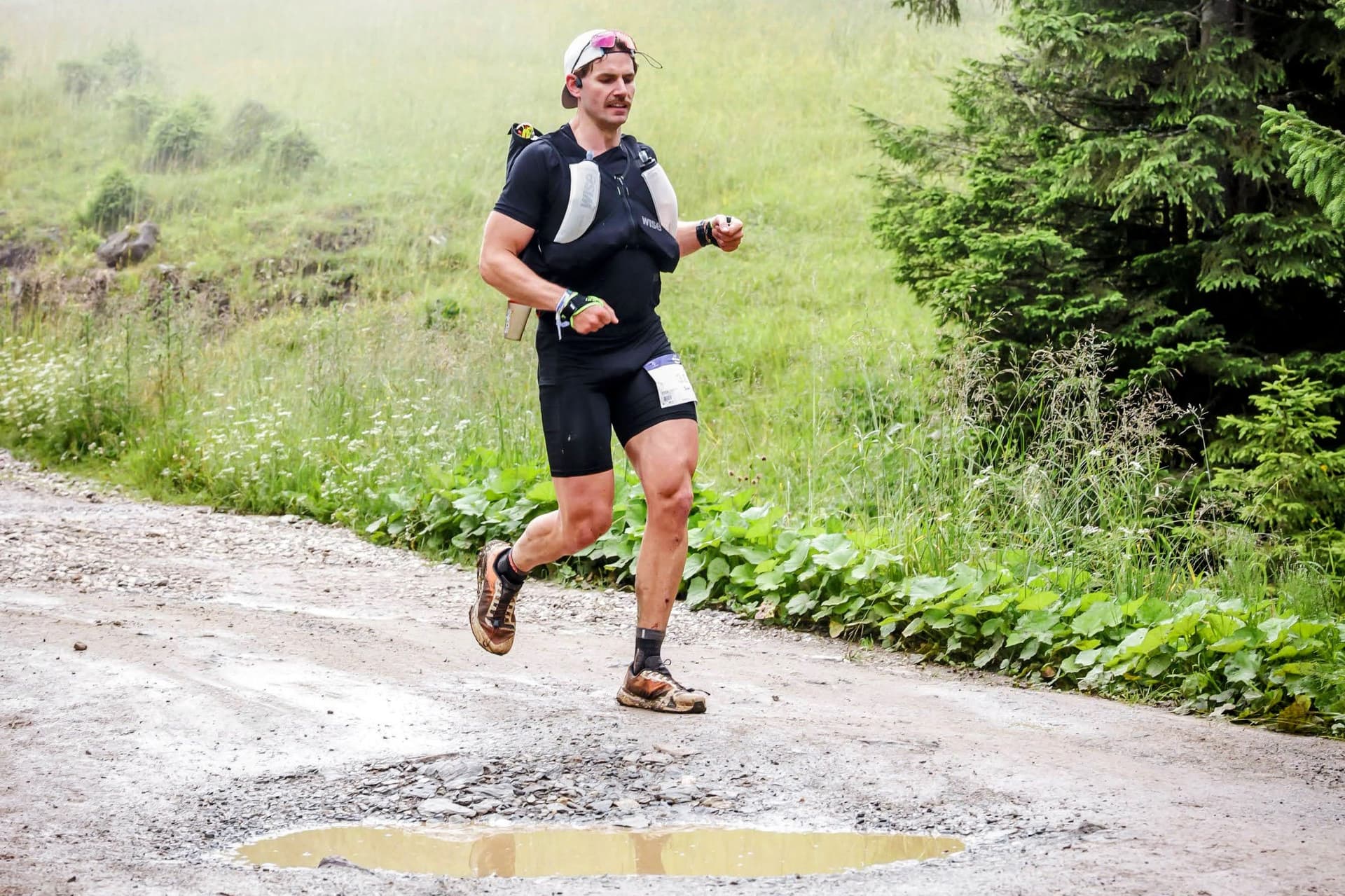
Bucovina Eco Retreat, Saturday 07:27, 8.6 km 498 m+ 1:27, 258th
First aid station, liquid only: I fill my flask with my pre-dosed powder, and I keep going. 258th out of 287 starters. Everything going to plan.
And now we attack the first serious piece: the climb to Rarău, a good 800 meters of climbing. Let's-go mode. My targets are simple: 150 bpm, 700 m/h of vertical speed maximum. I climb at my rhythm, alone or nearly. I trust myself, I move forward.
The climb continues up a ski slope, and when you start climbing a ski slope, you know what's coming. It's steep, but the terrain is easy. I catch back up with the two fifty-something Belgians who had passed me during my stop, we laugh. A Frenchman latches on, Alexandre, forty-ish, Romanian wife, lives in Germany. We climb together chatting, that way at least I'm sure I'm in zone 2. Meanwhile, the leaders of the 50 km, started an hour after us, begin to blast past us, no poles. The guy who would end up winning it, I had already crossed paths with in Slovenia in September, and he had won the 80 km there too. The trail world is small.
In the wooded part, things slow down a bit on the single tracks, and I use it to pass people. Carefully, because passing on a climb is treacherous: to get around someone going half a kilometer per hour slower than you, you have to put in a burst, and the HR spike is immediate. At some point, I realize Alexandre is no longer following. We come out of the forest onto a plateau that keeps climbing, and there: total fog. Ten meters of visibility, we've entered the cloud. I went, "That's a pretty light outfit... I hope this works out."
In hindsight, my data proves the pacing right: 649 m/h average up that first wall, right on target.
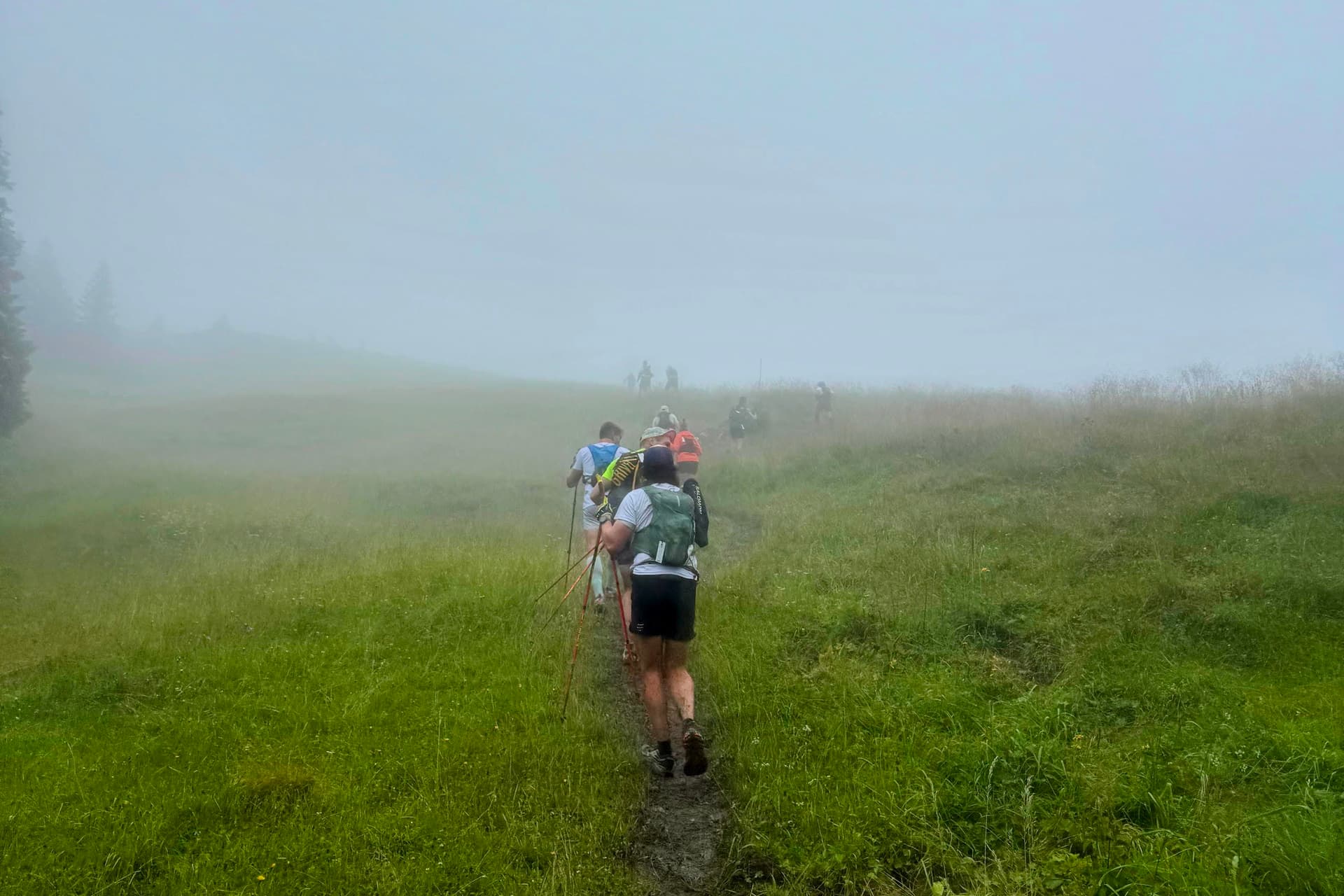
Rarău 1, Saturday 08:48, 13.6 km 1320 m+ 2:48, 216th
At the Rarău aid station, the first thing I see is an enormous barbecue, not yet lit. I stick to my basics: refill of the mix flask (I haven't even touched the electrolyte one, it's too cool to drink a liter an hour), a few biscuits. I do my refill in the middle of the lead women of the 50 km, and it's always a show: those runners live a different race, they want to go fast, they're shouting "attention, attention, let us through!". Our two worlds cross without touching.
One more short climb to the summit, then the long descent to Zugreni. And Zugreni, in my plan, is the end of the first section. The descent starts technical, then becomes a sort of dirt mountain road, half road half river, with rubble and water to dodge. And there, I unwind: HR under 120, downhill the heart isn't the limiting factor, pace around 6 minutes per kilometer. A touch faster than the plan ("it's fine, it's fine"), but the terrain is so runnable that it doesn't beat up the feet. I lengthen the stride, relaxed.
Around a bend, I run into... the Shokz-earphones guy from the morning, who is racing the 50 km and has caught up with me. He recognizes me and cheers me on: "You look good, you look strong, keep going!" It's always like that in trail races: people appear, disappear, reappear.
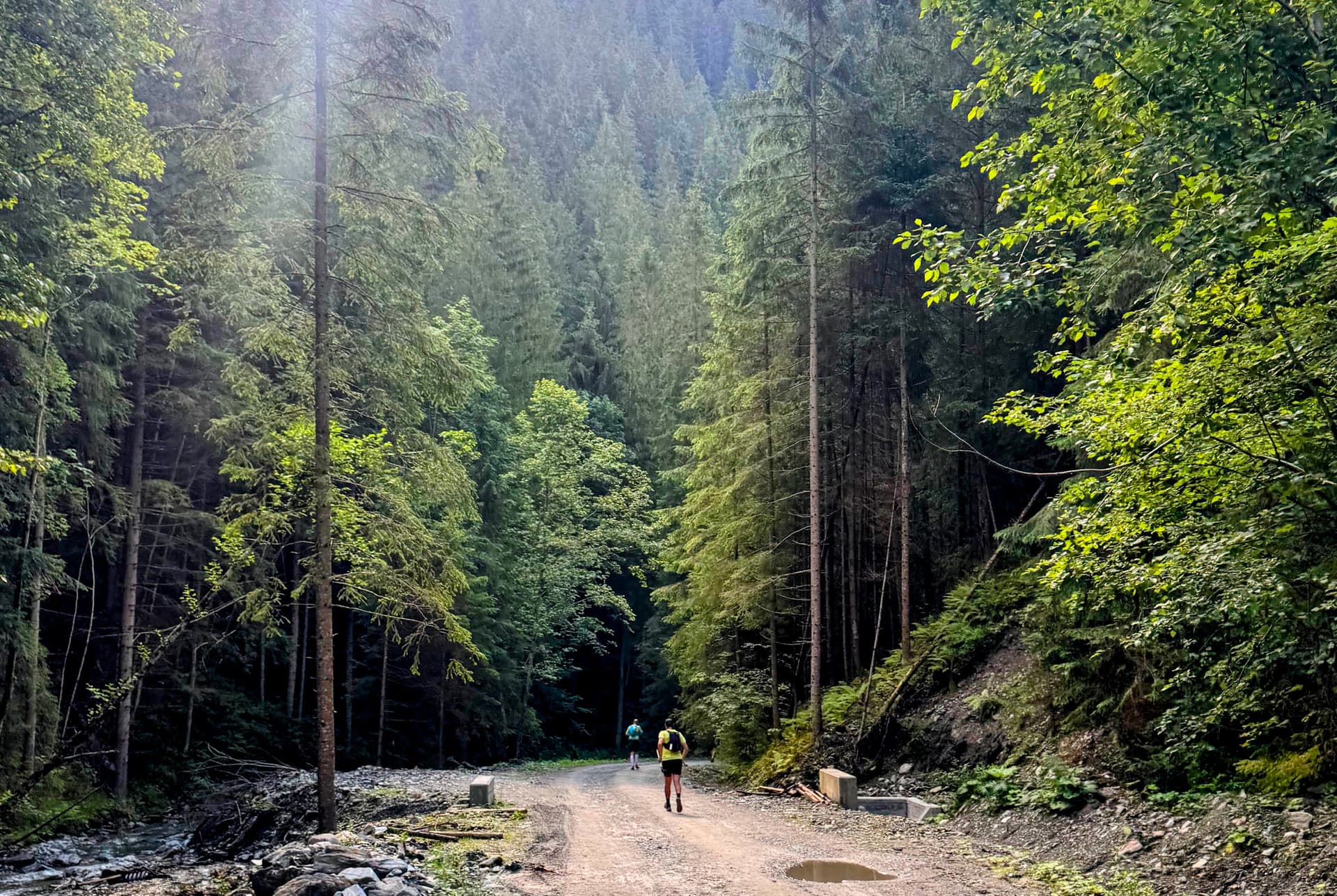
Just before the aid station, an image that sticks: a runner on the 114 km arrives past the cutoff, by about thirty minutes. Eliminated there, at kilometer 43 of her own race. Everyone lives their mountain the way they can.
Zugreni, Saturday 10:04, 23.2 km 1401 m+ 4:04, on schedule
Full refill at Zugreni, and as planned: both flasks with mix this time, because what's coming is the longest stretch of the race without real support. Leaving, a LiveTrail notification on my phone: 130th. Big doubt. At the previous checkpoint I was 216th, I did not pass 80 people in one descent. "Still, 130... that's not far off the top 100." I file the idea away in a corner of my head and don't really believe it. (I was right not to: it was a bug in the live ranking.)
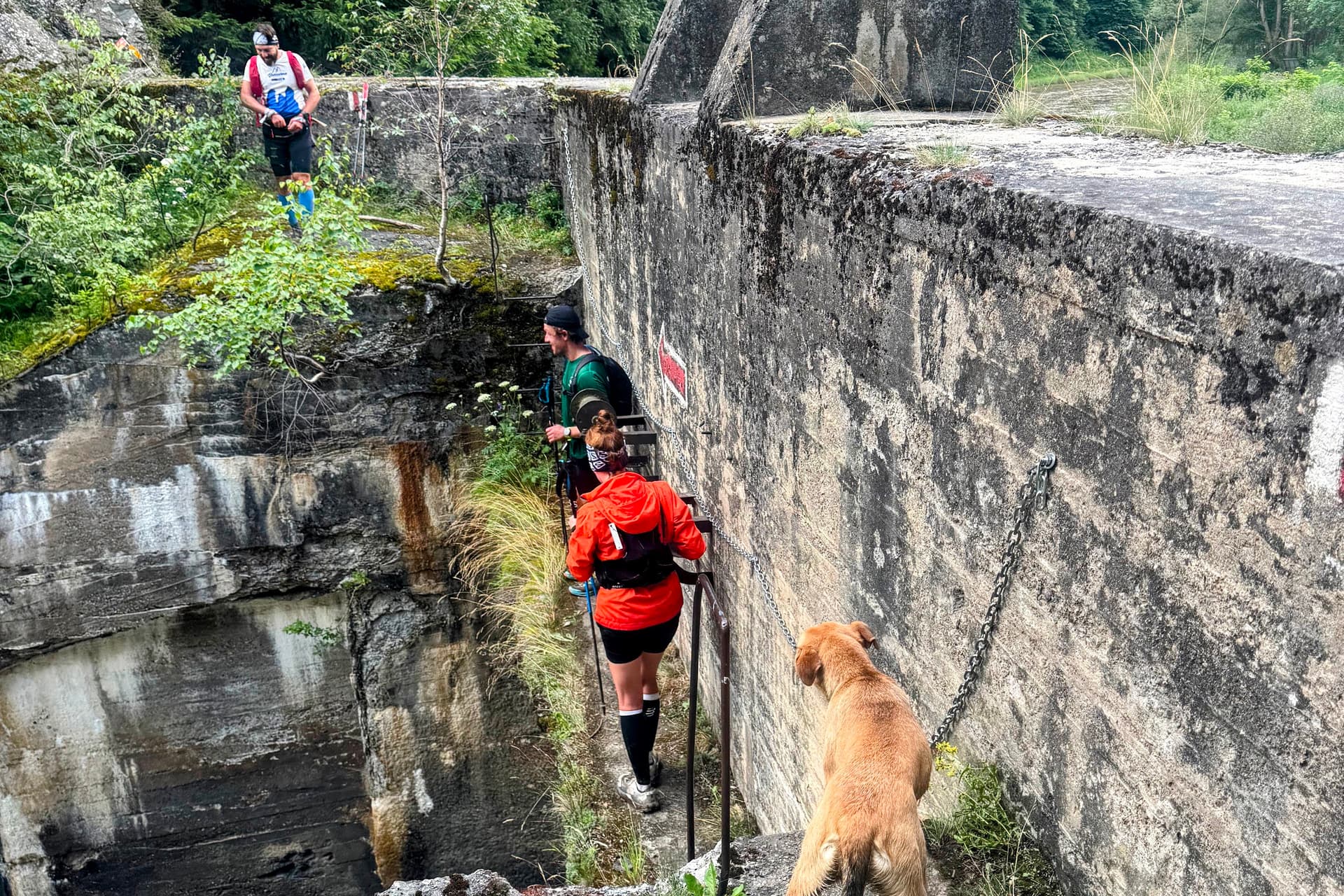
The exit from Zugreni is the most curious passage of the course. You follow the river on ten-centimeter-wide ledges with chains to hold on to, then you flat-out cross an old fitted stone dam: ladders, chains, twenty centimeters to place your feet. Nothing technically complicated, but you do wonder what you've gotten yourself into.
And then the ascent of the Pietrosul Bistriței begins. You start from 800 meters of altitude, there are 1000 to climb, and the start is extremely steep. Really extremely steep: in places, 400 meters of climbing over one kilometer. New section, new rules: authorization to climb at 155 bpm. Vertical speed, for its part, yo-yos between 550 and 900 depending on the gradient, and I decide to defer to the heart: as long as the HR holds, we're good.
What strikes me is the terrain. That kind of gradient, in Corsica, you climb it through big rocks and scree, no vegetation. Here, we're low, deep in the forest: dirt, roots, ferns, fallen trees. First time I climb a wall like that in scenery like that. At moments, single track obliges, it's a conga line behind slower runners. My GPS data will show about fifteen minutes lost to micro-stops in that climb. It happens in trail running. You breathe, you wait, you go again.
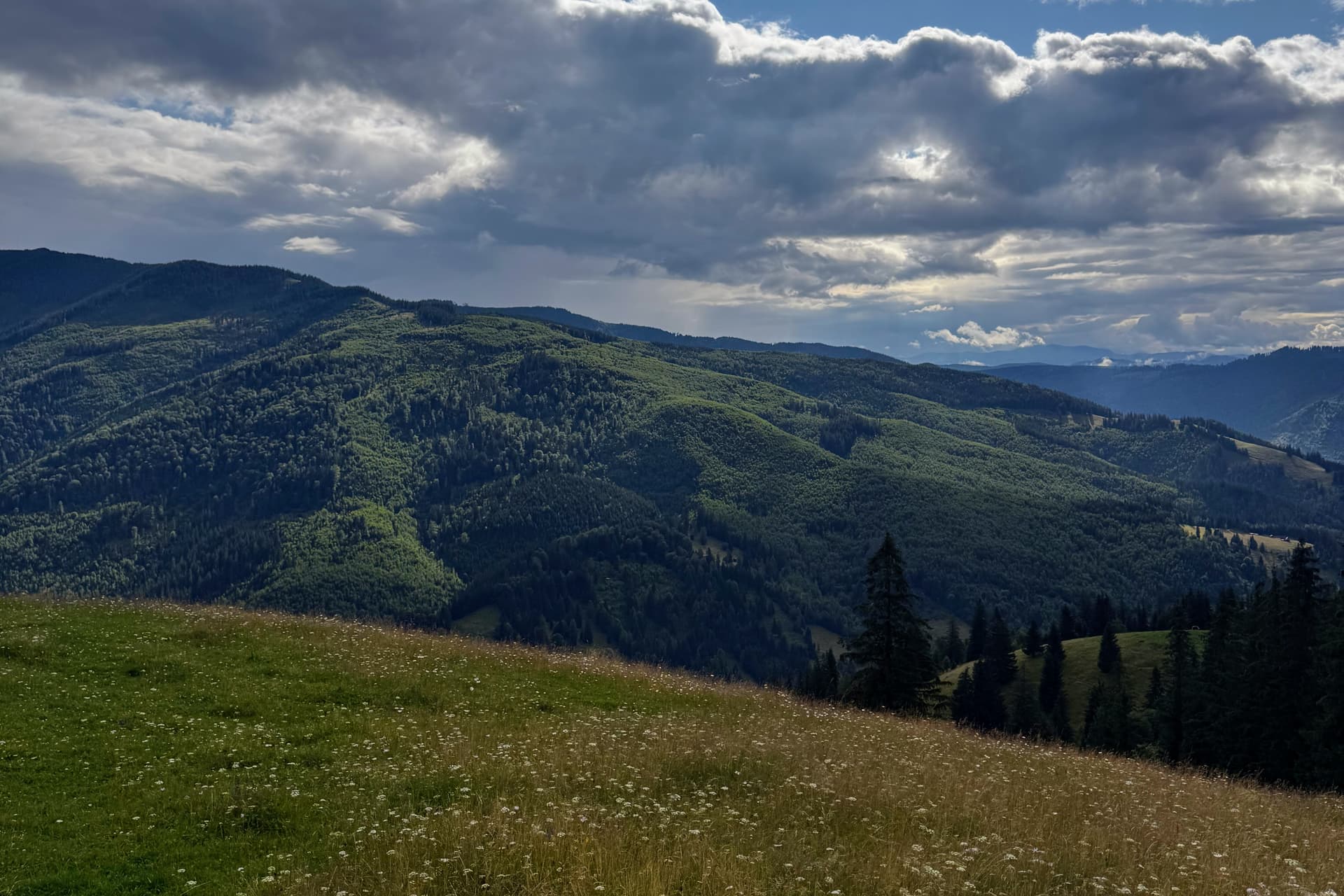
And then the reward: the trail pops out onto a kilometer-long ridge, and the view opens up all at once over the Bucovina valley. Magnificent. I soak it in, I'm happy, I move forward. At the top of summit number two, I take stock: half of the race's climbing is behind me, my legs feel good, and, the thing I've been watching since the Chouffe, no glute pain. None.
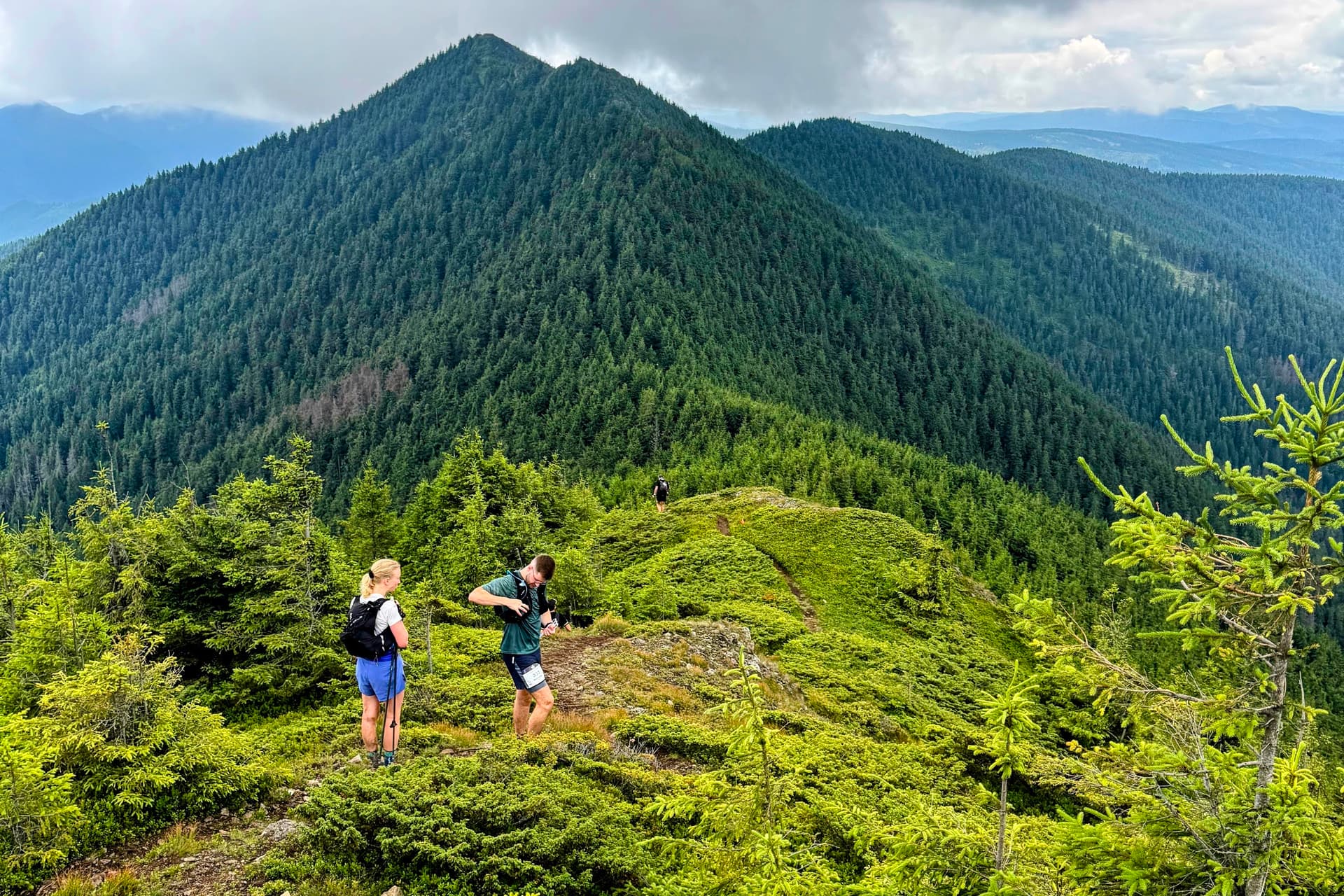
In the descent, a woman I had passed re-passes me. And that's exactly as it should be. Because my big lesson from previous races is that my limiting factor isn't the muscles: it's the impacts. Before, I used to hurtle down descents with long strides, letting myself fall. Physically economical, but every impact plows the feet, and late in a race, the slightest irregularity in the terrain becomes pain. So now: small steps, high cadence, total restraint. I still descend at 8-9 km/h, but I feel the quads absorbing every landing. That's the price. I pay it gladly.
Poiana Prislop, Saturday 12:42, 31.6 km 2503 m+ 6:42, 172nd
Flash aid station: flasks, a cup of Coke, gone. Right, let's talk about the aid stations. On the solid-food side, it's simple, no frills: dry biscuits, cake-like things. Nothing to dream about, but it does the job. My technique: a bite of biscuit, a sip of Coke to moisten, and down it goes. What matters is that the carbs go in.
The descent to Rusca is a delight: an exposed ridge, very beautiful, on a sort of double tractor track sloping gently down. The kind of terrain where I can open up without hurting myself. I string together 5-6 kilometers at 10 km/h, 6 minutes per kilometer. And when I see that on the watch, I smile, because it hasn't always been like that in my races.
One small complaint building up: all that mud has ended up getting grit into my shoes, and my feet are starting to heat up. Rusca arrives right on time.
Rusca, Saturday 13:34, 39.1 km 2546 m+ 7:34, 157th, halfway
I reach Rusca at 1:30 pm, almost exactly on my target. Halfway, on schedule, legs decent: on track.
Rusca, in my plan, was the big stop: the seated break, the reset, and, according to the program, hot food. So, the hot food of Rusca: a microwave and ready-made pouch meals, camping-style. Let's say I had imagined something else — if you ever race here and your plan relies on a real hot meal at halfway, better to know it beforehand. Mine, fortunately, counted on nobody: my refills, a Coke, and I use my five seated minutes for what really matters. Shoes off, fluff and gravel evacuated, clean re-lacing.
In my head, the briefing is simple: this third climb and the start of the descent that follows are the last stretch of management. After Transrarău, it's the release. And if I pass Transrarău before 4:45 pm, it means it's going to happen.
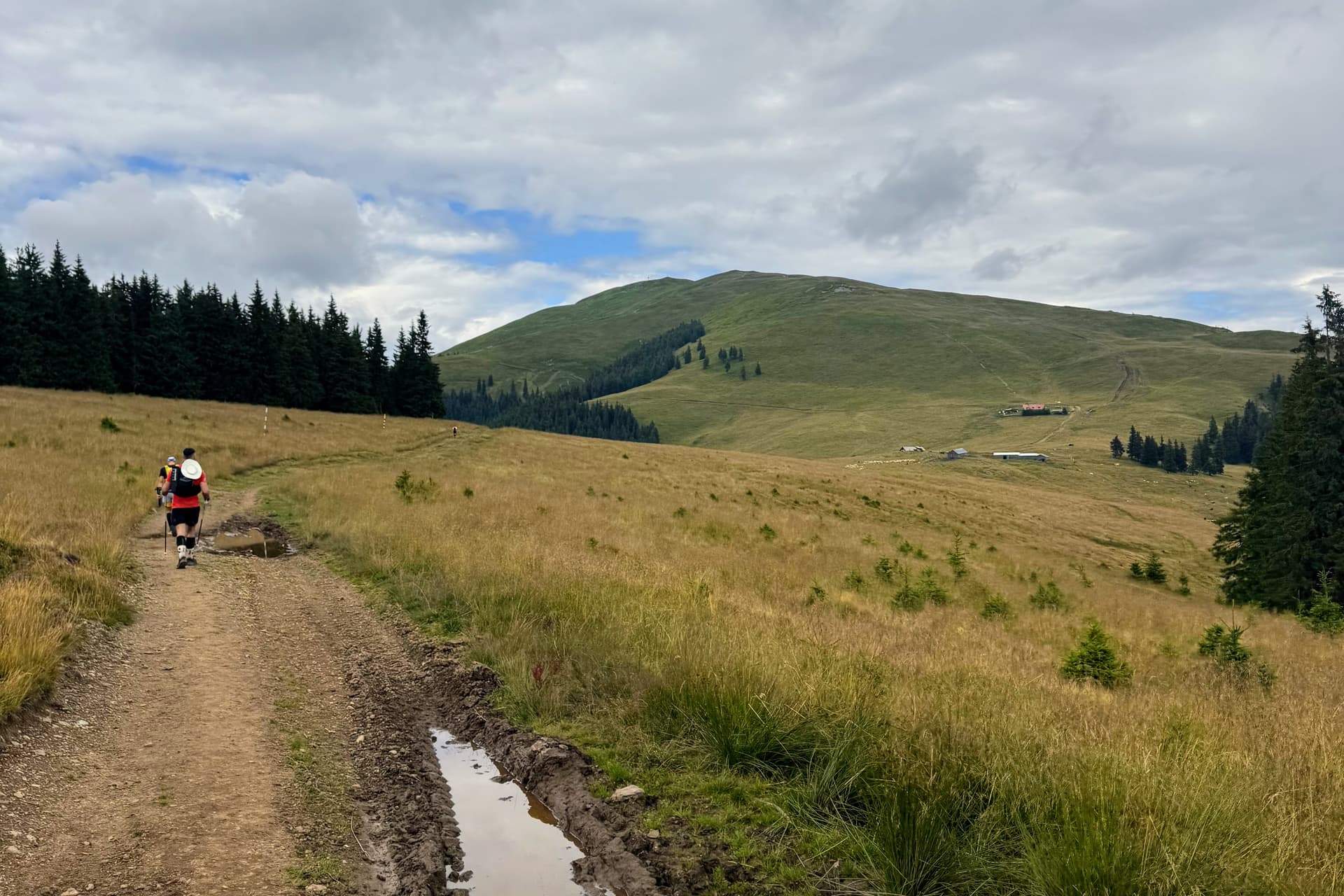
The climb to the high point unrolls like a metronome. Open terrain, ridgelines, I see runners ahead of me, and I see that I'm going faster than they are. I hold my pace, and the bibs fall one by one. ClimbPro shows me the remaining climb, I know exactly when to stow the poles, when to jog a flat. At Rusca, I saw my real position: 157th. And the little calculation settles in: "Can I still catch 50 people? Is this top 100 possible? That, that would be pretty incredible."
Cabana Giumalău, Saturday 15:15, 46 km 3345 m+ 9:15, 132nd
Refill at the hut, last top-up before the summit. 300 meters of climbing left. The end of the climb is beautiful and frankly easy: a big open expanse along the ridges, and still bibs falling. 1836 meters: the Giumalău, high point of my day, third summit out of four.
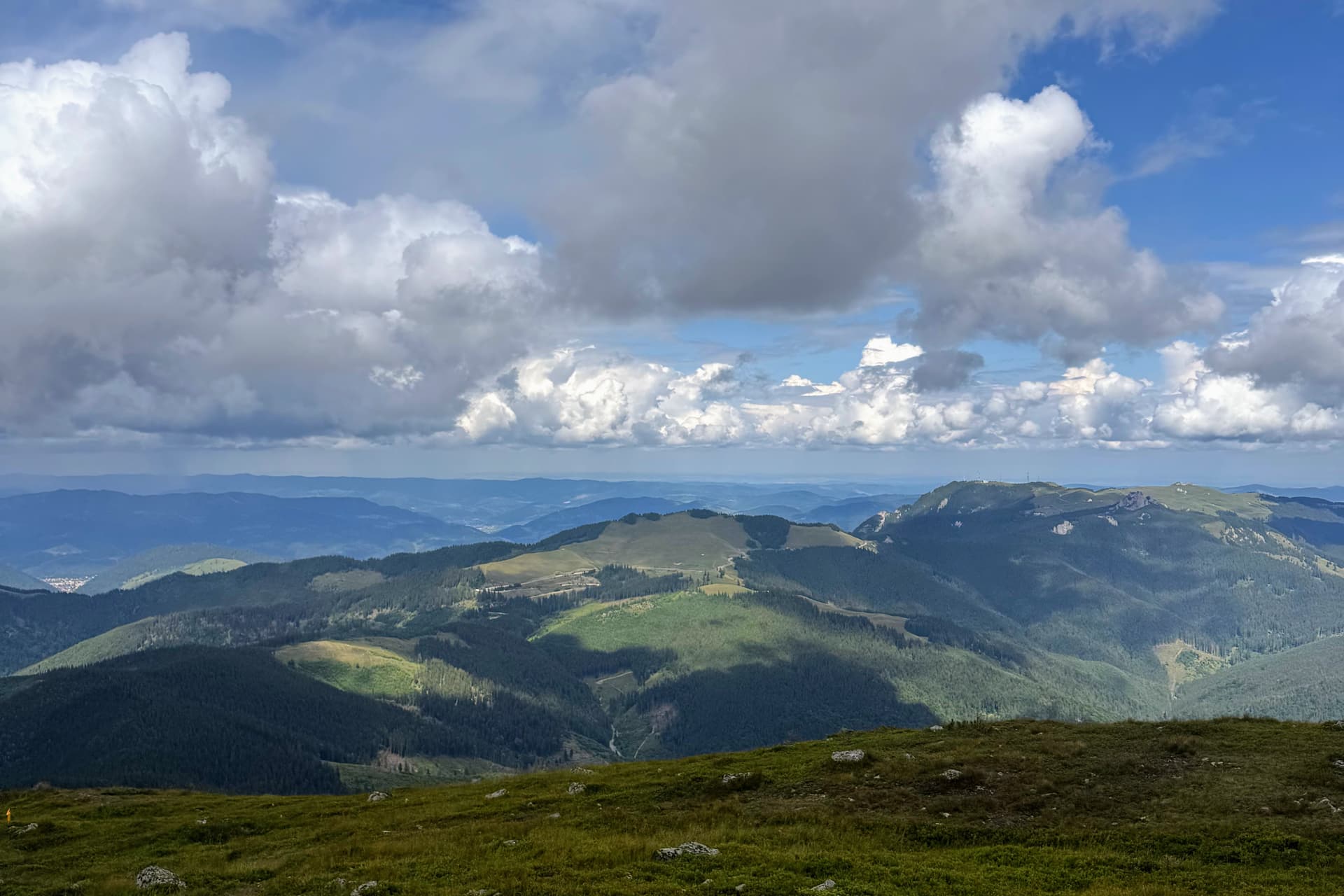
The descent starts technical, and it starts to drizzle. A guy I had caught re-passes me at full speed, the first since Rusca. I let him go: my descent is in parsimony mode, as agreed. But in my head, it's already singing: after Transrarău, I let everything go. The forest gets gentler, the terrain more and more runnable, I gradually lengthen the stride while keeping an eye on my HR. The cage opens soon.
Transrarău, Saturday 16:30, 52.5 km 3739 m+ 10:30, the release
Transrarău has to be earned: 150 meters of tricky climbing right before the refuge, in the rain, cap screwed down as a visor. And there, one of the nice surprises of the race: fifteen or so people massed on the slope cheering everyone on. Climbing through that is brilliant. At the aid station: Näak waffles, finally something other than dry biscuits! I indulge. I see the crazy descender who had passed me again, and I set off after him.
4:30 pm. Fifteen minutes ahead of the barrier I had set myself. Glutes, stomach and feet: OK. Every box ticked.
My race starts now.
And I let loose. The big descent toward Adam and Eva, I bomb it. I run, I hold nothing back, and I catch myself talking out loud, literally, like the crazy guy on the bus: "Release. Release. Release." I'm saying it to my legs. The bib didn't beep at the Transrarău checkpoint, no way to know my ranking. Doesn't matter: I count the bibs myself. And they fall, they fall. "I'm going to do it. This top 100, this sub-14 hours, I'm going to do it."
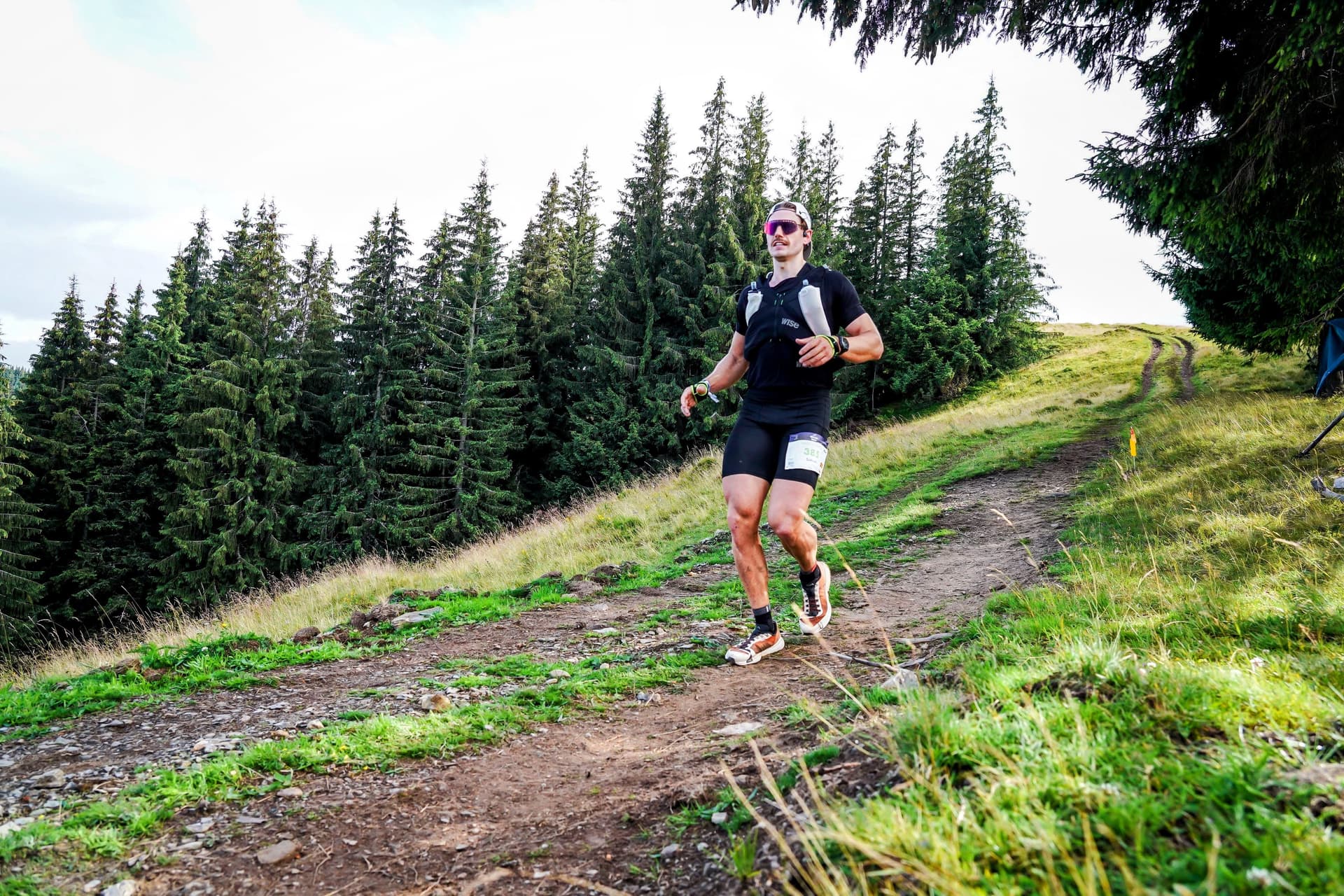
On the open ridges, you can see far ahead: every distant runner becomes a target. And then at some point, between two showers, a rainbow draws itself over the valley. It will have been between 10 and 20 degrees all day, alternating bright spells and drizzle. For me who fears the heat, the perfect weather.
Fuel-wise, I switch to end-of-race mode: first caffeinated gel (130 mg, the big format), and a little calculation. About two hours left, so I drop the 80-minute interval, the two remaining gels will go in over the next two hours. My aid-station technique is now dialed to the millimeter: the powder is poured into the flasks before arriving, the volunteers, adorable, refill my bottles, sticky as they are, while I eat, and I'm gone in 60 seconds.
Adam & Eva, Saturday 18:06, 62.3 km 3998 m+ 12:06, 105th
At Adam and Eva, the checkpoint finally speaks: 105th. The top 100 is six bibs away.
The terrain is flat, rolling, and I'm cruising above 10 km/h, at kilometer 63 of a mountain ultra. I'm not even looking at my HR anymore. A guy re-passes me on the false flat I had sworn to myself I would run: "Damn, he's got juice, the top 100 is in danger." Then he stops, and I take him back. On the next rise, I bank a few more. And then comes the moment I won't forget: six silhouettes in single file, far ahead. I count under my breath: "104... 103... 102... 101... 100... 99." I go get them one by one. The people I pass cheer me on. At this hour of the race, almost nobody arrives with freshness left, and it shows. I pass the lead woman of the 114 km. My data will say I was still climbing at 650 m/h of vertical speed at that point. At kilometer 65.
Then one last descent, and ahead of me stands the fourth summit: the Runc. On the course profile, I had looked down on it. 400 m of climbing after the day's three monsters, "a little joke, basically". It's almost 7 pm. If I get over it in under an hour, the sub-14 is mine.
Pârâul Mesteacăn, Saturday 18:57, 68.5 km 4266 m+ 12:57, 95th
The last aid station, I literally run through it. I don't stop, the volunteers applaud, and I launch into the climb of the Runc.
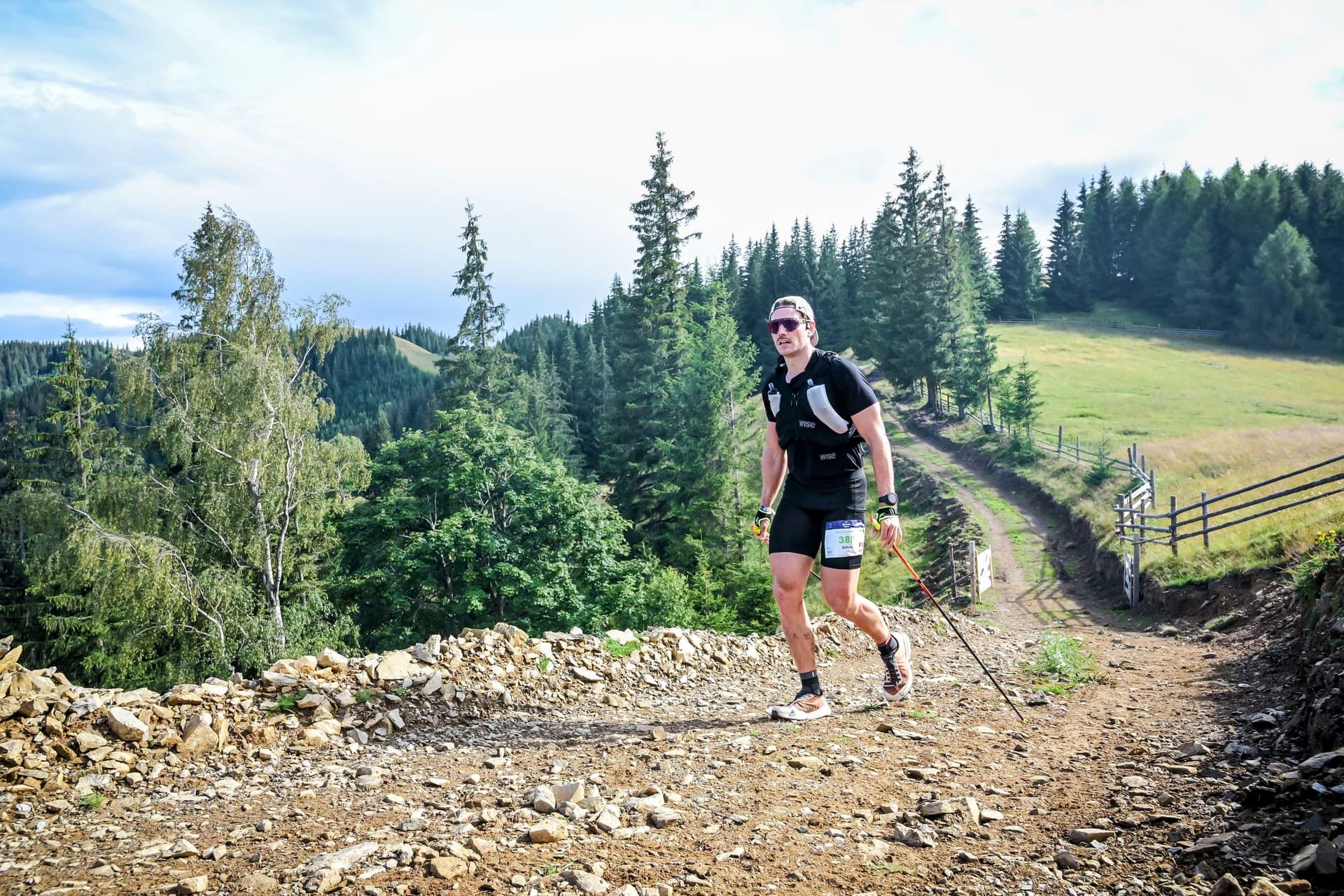
And there, I get the joke. The Runc is 400 meters of climbing over 1.3 kilometers, with sections above 35%. An absolute madman's idea, placed at kilometer 69 by people who knew exactly what they were doing. The race director writes it himself: it's from difficulty that memories are born. I force down my last caffeinated gel (mango flavor, my least favorite, of course) and I climb. I climb, I climb. And I keep passing people. Right then, my earphones shut down, out of battery, this last section will be without music.
It's there, somewhere on that absurd slope, that it happens: I start crying. Hot tears, for 45 seconds, like I have rarely cried. There's no reason. Well yes, there is every reason in the world. I'm going to do it. I'm going to finish an ultra running. Not surviving, not gritting my teeth through the night: running, from the first kilometer to the last. That was exactly the goal. After Corsica finished walking, after Slovenia in management mode, here I am, at the summit of my race, with legs that respond, not a single niggle, and a clock holding out its arms to me.

My GPS data would later reveal the number that sums it all up: 763 meters per hour of vertical speed in the Runc. The fastest climb of my entire day, faster than the first wall climbed on fresh legs, thirteen hours earlier. The perfect negative split, all the way into the final slope.
On the way up, I hear a girl asking how much climbing is left to the summit. I look at my ClimbPro: "20 meters." And she wants it, she charges.
Runc, Saturday 19:30, 69.7 km 4664 m+ 13:30, 87th
At the top, I tell myself: alright, time to enjoy this. Poles stowed, cap off, sunglasses in the hair. 2.5 kilometers left, all downhill.
Except this descent is the iconic passage of the race: thousands of runners from every format have come through since the day before, and it has become a full-on mud toboggan. I slip, I slide, I still barrel down at more than 10 km/h. And the girl from the summit, Sophie, is on my heels.
We pop out onto the flat of Câmpulung, and I shift up a gear: under 5 minutes per kilometer, then flirting with 4. The arch is there, at the end of the street. And then, I hear Sophie accelerating behind me. She wants to take me in a sprint. "No, that's not how this is going to go." And I sprint too, at the end of a 72 K, like two kids. Except my sunglasses fly off my hair. U-turn to pick them up, and Sophie streaks toward the line. She got me. Haha, well played to her.
Finish, Câmpulung Moldovenesc, Saturday 19:47, 72.2 km 4722 m+, 13:47:19, 87th
We cross the line a few seconds apart and hug. All the way down the descent, we had been hyping each other up in English: "We're going to do it, sub fourteen!", "We're going to be top 100!"
13 hours, 47 minutes, 19 seconds. 87th out of 287 starters. Started 258th at the first checkpoint, second-to-last group, exactly where I had placed myself, climbed back 171 places without ever giving a single one back. Average heart rate over the day: 138 bpm, against 158 at the Chouffe, which lasted half as long. Both goals, sub-14h and top 100, ticked in the last hour of the race.

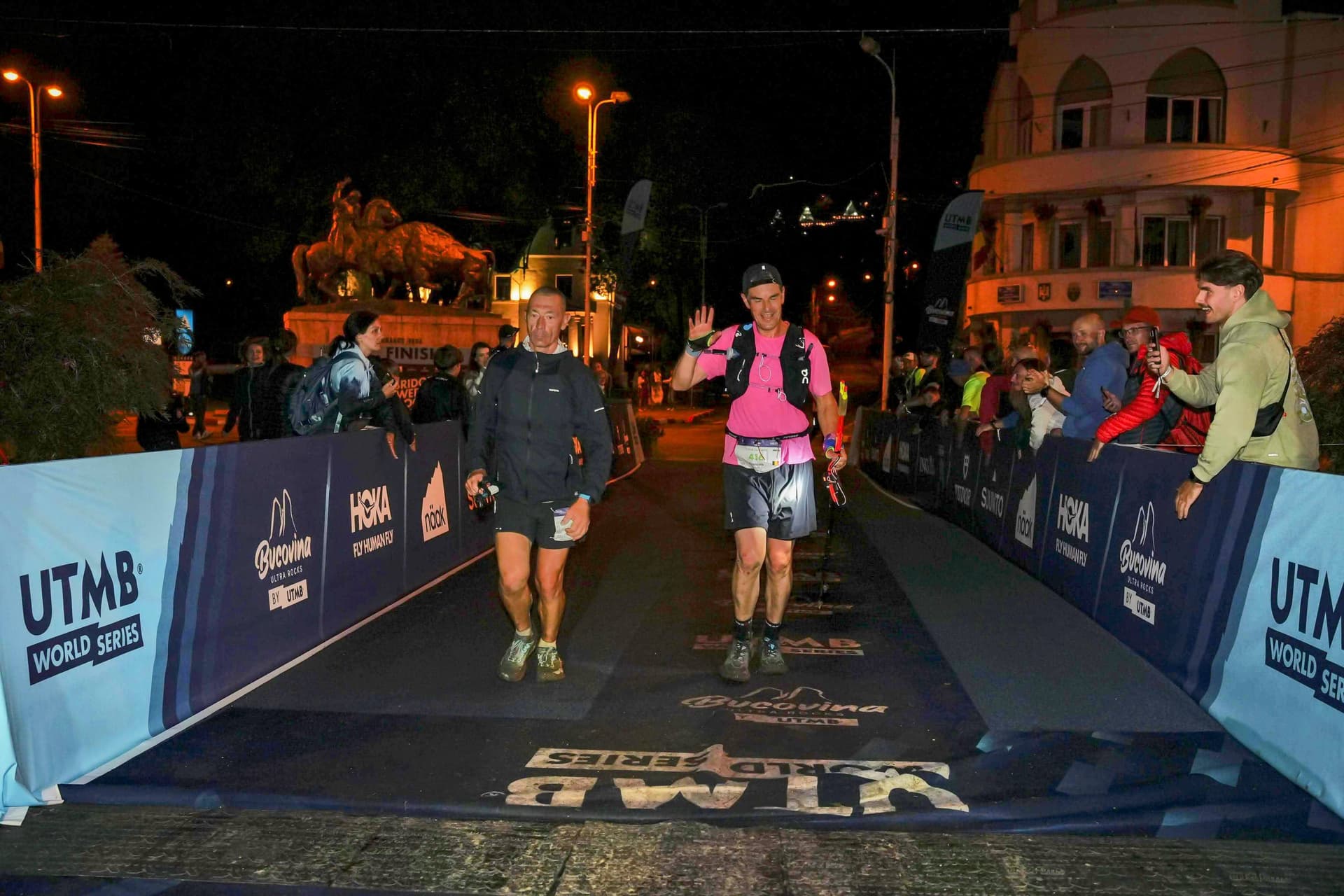
The post-race is a mirror of the day. A shower at the village, where I meet Filip, a Czech crossed... at my race in Slovenia (28th of the 120 km there, when I had finished 338th, the trail world really is tiny), who has lived through a black day on the 114 km: headlamp lost, pole broken, second headlamp broken. Then the hot buffet, where I mostly drink soup, taking my sweet time. And then I look at the tracker: JF and François arrive in twenty minutes. So I wait for them, and I film their finish. François completes his first 70 km, accompanied by his lifelong buddy, and then we debrief the race together. That's when I see Sophie walk past us... speaking perfect French on the phone. "Wait, you speak French?!" German, one French parent. We will have sprinted against each other shouting encouragement in English for nothing.
I drive home after dark, at the end of a day that looked, from start to finish, like a normal day. A normal day with four summits in it.
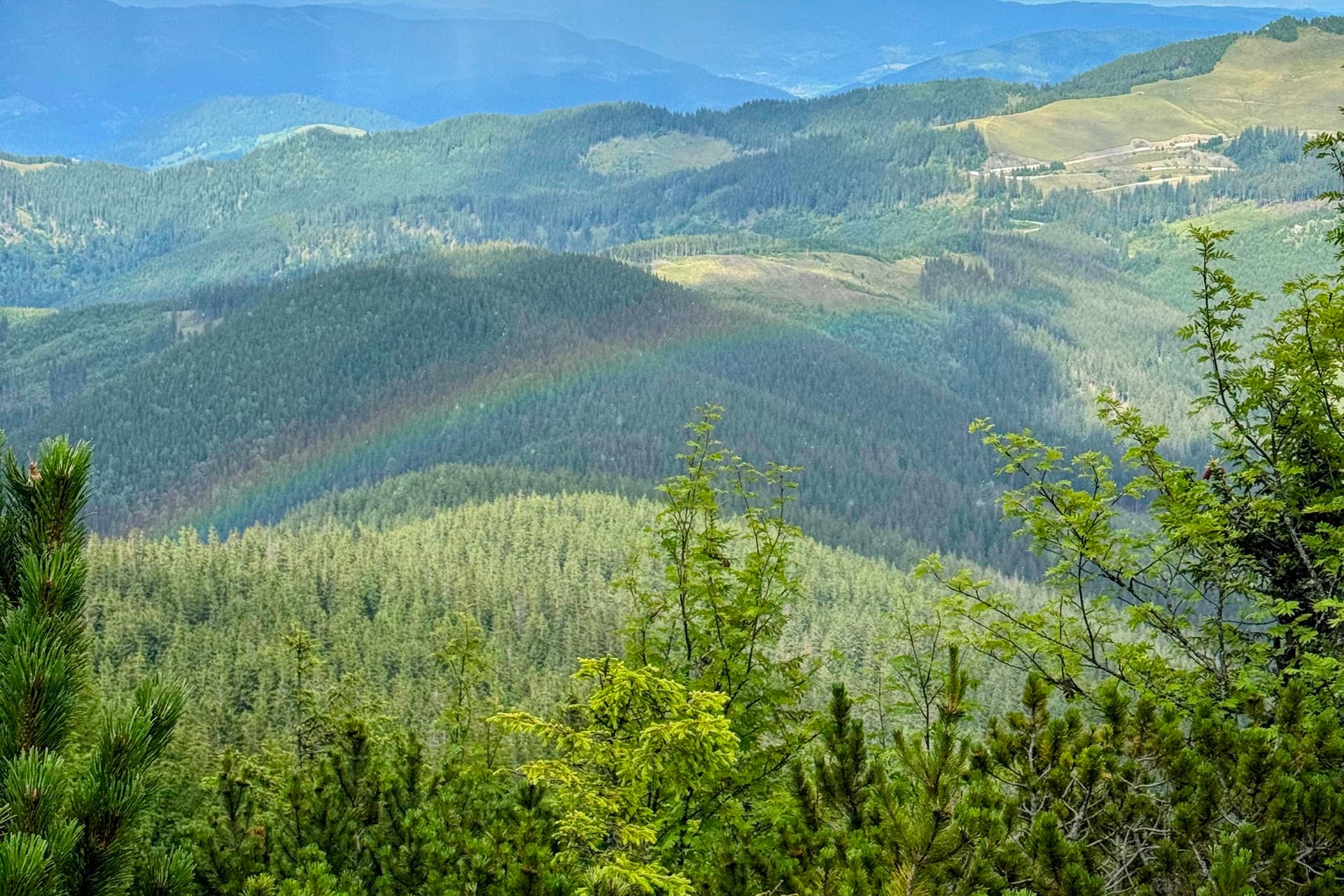
And it has to be said: this race is superbly organized — flawless course marking, golden volunteers, cheers all the way up the steepest slopes. Thank you to the Bucovina Ultra Rocks team: just look at the smile I had climbing the Runc, a few photos up, and you'll understand. Honestly, a beautiful experience.
What I take away
This race is the demonstration I was hoping for: you can transform the way you run an ultra without transforming your training volume, provided you run intelligently. With 35 km a week on average and zero long runs, but a well-exploited crash test, a numbers-based pacing plan, nutrition thought out to the gram with Matthis and a well-configured watch, I did exactly what I had come to do: run, from the first kilometer to the last.
The discipline of the early hours is the only real expense of this race: being 258th and last at the first checkpoint knowing, hoping, that the race would come to me. It came. The last 20 kilometers, run bib-hunting with fresh legs at kilometer 65, will remain among my finest moments in a race.
And then there's one little number that makes me particularly happy: with this race, I finally break the 500-point bar on the UTMB Index — 508, where I had been capped at 489 until now. The data confirming the feeling: quite simply my best race.
| Checkpoint | km | Rank | Time of day | Elapsed | Cumulative gain |
|---|---|---|---|---|---|
| Start Câmpulung | 0 km | – | Sat 06:00 | 0:00:00 | 0 m+ |
| Bucovina Eco Retreat | 8.6 km | 258 | Sat 07:27 | 1:27:56 | 498 m+ |
| Rarău 1 | 13.6 km | 216 (+42) | Sat 08:48 | 2:48:05 | 1320 m+ |
| Zugreni | 23.2 km | – * | Sat 10:04 | 4:04:50 | 1401 m+ |
| Pietrosul Bistriței | 29 km | 173 (+43) | Sat 12:17 | 6:17:48 | 2489 m+ |
| Poiana Prislop | 31.6 km | 172 (+1) | Sat 12:42 | 6:42:41 | 2503 m+ |
| Rusca | 39.1 km | 157 (+15) | Sat 13:34 | 7:34:47 | 2546 m+ |
| Cabana Giumalău | 46 km | 132 (+25) | Sat 15:15 | 9:15:49 | 3345 m+ |
| Giumalău 1 | 47.4 km | 125 (+7) | Sat 15:45 | 9:45:29 | 3634 m+ |
| Transrarău | 52.5 km | – (no checkpoint) | – | – | 3739 m+ |
| Adam & Eva | 62.3 km | 105 (+20) | Sat 18:06 | 12:06:33 | 3998 m+ |
| P. Mesteacăn | 68.5 km | 95 (+10) | Sat 18:57 | 12:57:11 | 4266 m+ |
| Runc | 69.7 km | 87 (+8) | Sat 19:30 | 13:30:50 | 4664 m+ |
| Finish | 72.2 km | 87 | Sat 19:47 | 13:47:19 | 4722 m+ |
* The ranking shown at Zugreni (131st) was a live-tracking error: the real progression goes straight from 216th to 173rd at the Pietrosul.
And now? The immediate next step is another 100K at the end of October, in Mallorca. Then will come the build-up to the 2027 season, and we'll see what it has to tell. But what really excites me is something else. This year, I clearly improved while my training happened as best it could: all of that progress came from the surroundings, the experience, the strategy, the execution. And that experience will keep growing race after race. If on top of that I can get back to training the way I want to, then the margin is still enormous, on both sides at once: in the lived experience that keeps stacking up, and in the training, where I know I haven't yet gone to get everything there is to get. That's exactly what motivates me. See you in Mallorca.